Custom Software vs Off-the-Shelf: When a Local Business Should Build Its Own Tool
Quick answer: Most local businesses should run on off-the-shelf software and only build custom when a specific workflow is core to how they make money and no existing tool fits it well. Custom software earns its cost when it removes real friction, replaces a stack of subscriptions and manual steps, or becomes a competitive advantage. It is the wrong choice when an existing tool does 90% of the job - then you are paying to rebuild what already exists. The honest test: build only the piece that is genuinely yours, and buy everything else.
Published 2026-06-14, updated 2026-06-16 · Custom Software · by AdForce

You are juggling four subscriptions, a spreadsheet, and a group chat to run one process that is core to your business - and every one of them does part of the job badly. The thought creeps in: "we should just build our own." Sometimes that is exactly right. Often it is an expensive way to rebuild something you could have bought. This guide is the honest test for telling them apart.
We build custom software, so you might expect a pitch. You will get the opposite: most of the time, the right answer is to buy, not build. The few times it is build, the payoff is large - and knowing the difference is the whole game.
What counts as "custom software"
Custom software is anything built specifically for your business rather than bought off a shelf: a booking flow no platform supports, a quoting calculator wired to your pricing, an internal dashboard that pulls your real numbers into one place, a customer portal, or an integration that makes two tools you already pay for finally talk to each other. It does not have to be a sprawling app. The best custom builds are often small and surgical.
The reframe: build the 10%, buy the 90%
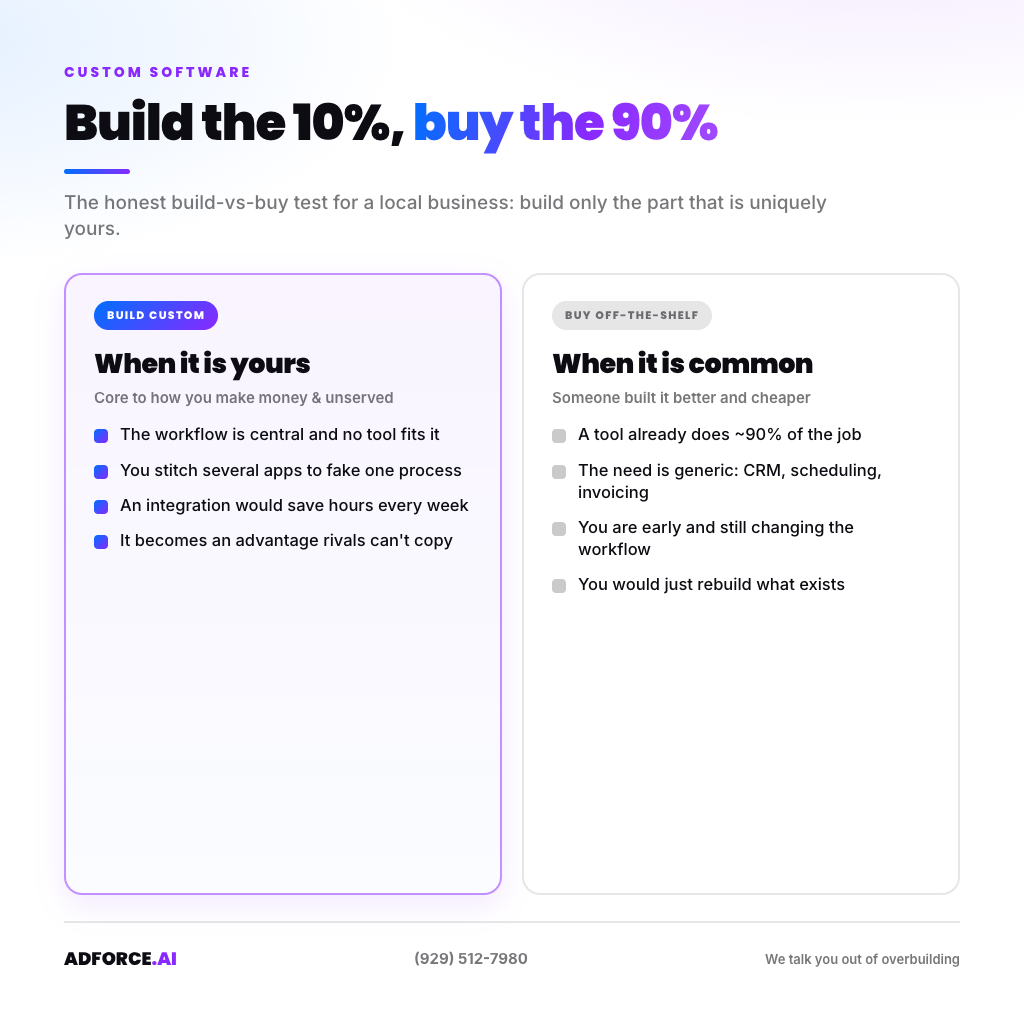
The expensive mistake is deciding to "build our own system" and then recreating a CRM, a calendar, an email tool, and an invoicing app - all of which already exist and are cheap. The smart move is the opposite: buy the 90% that is the same as everyone else, and build only the 10% that is genuinely yours. A custom quoting engine that plugs into off-the-shelf CRM and invoicing beats a from-scratch platform on cost, speed, and risk every time.
This is the same logic behind marketing automation: use proven tools for the common parts, and add a custom layer only where your workflow is genuinely different.
When custom software is worth it
Build when one or more of these is clearly true:
- The workflow is core to how you make money and no tool fits it. If the awkward process is the heart of your business, a custom fit can become an edge competitors cannot copy.
- You are paying for and stitching together several tools to fake one workflow, and the duct-tape is costing real time and errors.
- An integration would save hours every week but no off-the-shelf connector exists.
- You have a repeatable, ownable advantage - a calculator, a portal, a piece of automation - that would make customers choose you.
When to buy instead
- An existing tool does roughly 90% of what you need. Adapt your process to it.
- The need is common (CRM, scheduling, invoicing, email). Someone has already built it better and cheaper than you can.
- You are early and still figuring out the workflow. Do not pour concrete on a process you will change next quarter.
Real math: SaaS stack vs. a custom build (3 years)
Numbers depend heavily on scope, so treat these as illustrative ranges, not quotes. The point is the shape of the decision.
| Off-the-shelf stack | Targeted custom build | |
|---|---|---|
| Up-front cost | Low (sign-up only) | Higher (one-time build) |
| Monthly cost | Several subscriptions, growing with seats/usage | Hosting plus light maintenance |
| Fit to your workflow | Good for common needs, awkward for unusual ones | Built exactly to your process |
| Who owns it | The vendor (you rent) | You |
| Best when | The need is common | The need is core and unserved |
Over three years, a pile of per-seat subscriptions that grows with your team can quietly overtake the cost of a focused custom tool you own outright - but only if that tool removes real, recurring friction. If it is a nice-to-have, the subscriptions win. Be honest about which one you have.
How to build without getting burned
- Start with the smallest useful version. Ship the one workflow that hurts most, learn, then expand. Avoid the big-bang build.
- Own your code and data. Insist on it. Renting a "custom" black box is the worst of both worlds.
- Integrate, do not replace. Keep the off-the-shelf tools that work; connect to them.
- Insist on a real handoff. Documentation, accounts in your name, and a plan for who maintains it.
A good custom website is often the front half of this - the same team that builds your site can build the calculator, portal, or automation behind it, so the pieces actually fit together.
How AdForce approaches custom builds
We start by trying to talk you out of it. If an off-the-shelf tool does the job, we will tell you and help you set it up. When a custom build genuinely pays off, we scope the smallest version that delivers value, build it to integrate with what you already use, and hand it over as something you own. It is the same people-led, AI-assisted philosophy that runs through choosing the right marketing partner and our AI business agents. Wondering whether your situation is a build or a buy? Book a free 15-minute call and we will give you a straight answer.
Frequently asked questions
Is custom software worth it for a small local business?
Sometimes. It is worth it when a workflow that is core to how you make money has no good off-the-shelf fit, or when a small custom tool replaces a costly, error-prone stack of subscriptions and manual steps. For common needs like CRM or scheduling, buying is almost always smarter.
How much does custom software cost?
It depends entirely on scope, so be wary of anyone quoting a flat number sight unseen. The cost-controlling principle is to build only the part that is uniquely yours and integrate proven tools for everything else, which keeps a build focused and far cheaper than a from-scratch platform.
Should I build my own CRM?
Almost never. CRMs are a solved, competitive category, so you would be paying to rebuild something that already exists and works well. The better move is to buy a CRM and build only the custom piece your business genuinely needs, then connect the two.
What is the difference between custom software and off-the-shelf?
Off-the-shelf software is bought ready-made and shared by many businesses; custom software is built specifically for yours. Off-the-shelf wins on cost and speed for common needs. Custom wins when your workflow is genuinely different and central to your revenue.
How do I avoid overspending on a custom build?
Start with the smallest useful version that solves your most painful single workflow, integrate rather than replace your existing tools, own your code and data, and expand only once it proves its value. Big-bang builds are where budgets go to die.
Will I own the software you build?
Yes. We build custom software as something you own outright, with your accounts, your data, and a real handoff including documentation. Renting a black box you cannot maintain or move is the outcome we help clients avoid.
Can custom software give me a competitive advantage?
It can, when it is built around a workflow that is core to your business and hard for competitors to copy - a unique quoting tool, customer portal, or piece of automation. If the tool is generic, the advantage is not, so build for what is genuinely yours.