Google Ads vs Facebook Ads: Which Should You Spend On First? (2026)
Quick answer: Google Ads captures existing demand - people who are already searching for what you sell - so it is the faster path to leads and sales. Facebook and Instagram Ads create demand by putting you in front of people who fit your customer profile but were not searching yet, so they are better for awareness, new offers, and cheaper reach. If you need calls or bookings now, start with Google. If you need to fill the top of the funnel or launch something new, start with Meta. Most businesses that can afford it eventually run both, because search closes the demand that social creates.
Published 2026-07-07 · Paid Ads · by AdForce

You have a budget to put behind ads and one nagging question: does it go into Google or Facebook? Pick wrong and you either pay premium prices to reach people who are not ready, or you run beautiful awareness campaigns while your phone stays quiet. The good news is this is not a coin flip. The right answer follows directly from what you are trying to make happen this quarter.
Both platforms target well, both charge you only when they should, and both report in detail. The difference that actually matters is not features. It is intent.
The one distinction that decides everything: intent vs. discovery
Google Ads is an intent engine. Someone types "emergency plumber near me" or "CRM for contractors," and your ad meets them at the exact moment they are looking. You are not convincing anyone they have a problem - they already know, and they are shopping. That is why Google clicks cost more and convert faster.
Facebook and Instagram Ads are a discovery engine. Nobody opens Instagram to buy a water heater. Meta uses its data to put your offer in front of people who match your best customers based on their interests, behavior, and lookalike patterns, while they are scrolling. You are creating demand, not catching it. That is why Meta reach is cheaper but usually needs more nurturing before it turns into a sale.
Everything else - budgets, formats, bidding - flows from that single split. Hold onto it and the rest of this guide is just detail.
What Google Ads is best at
- Capturing "ready to buy" searches. High-intent keywords put you in front of people actively looking. This is the shortest path from spend to a booked job.
- Time-sensitive and local demand. "Open now," "near me," and same-day searches convert quickly. Local service ads and search ads shine here.
- Predictable lead flow. Once a campaign is dialed in, you can often forecast roughly what a lead costs, which makes budgeting sane.
The trade-off: competitive keywords get expensive, and a poorly structured account bleeds money fast. Google rewards tight campaigns and punishes lazy ones. Our Google Ads service exists mostly to stop that bleed.
What Facebook and Instagram Ads are best at
- Building awareness and demand. Reach people who have never heard of you but look exactly like the customers you already love.
- Launching something new. A new offer, location, or product needs eyeballs before anyone searches for it by name. Meta is how you create that search demand in the first place.
- Cheaper reach and richer creative. Video, carousels, and story formats let you tell a story and stay memorable at a lower cost per impression.
- Precise audience targeting. Interests, behaviors, custom audiences, and lookalikes let you get specific about who sees you.
The trade-off: because you are interrupting rather than answering, it takes stronger creative and more follow-up to convert. Ad fatigue is real - the same image stops working, so fresh creative is a running cost, not a one-time task. That is the heart of what we manage in Facebook and Instagram Ads.
Real math: what each platform actually costs you
There is no universal price - it swings with your industry and competition - but here is the honest shape of the decision for a typical local or service business.
| Google Ads | Facebook / Instagram Ads | |
|---|---|---|
| Buyer mindset | Actively searching (high intent) | Scrolling (discovery) |
| Typical cost per click | Higher | Lower |
| Speed to first leads | Fast | Slower (needs nurturing) |
| Best for | Calls, bookings, "I need it now" | Awareness, launches, retargeting |
| Creative burden | Lower (text + a few assets) | Higher (fresh video/images often) |
| Where the money leaks | Bad keyword/account structure | Ad fatigue, weak follow-up |
The reframe most owners miss: cheaper clicks are not cheaper customers. Meta's lower cost per click can still cost more per booked job if those clicks are not ready to buy. Judge every platform on cost per lead and cost per sale, never on cost per click.
So which do you start with?
- You need leads or calls this month. Start with Google. You are buying existing demand, and it converts fastest.
- You are launching a new offer, product, or location. Start with Meta. You have to create awareness before anyone searches for you by name.
- You have a time-sensitive promotion. Google captures the people already hunting for that kind of deal.
- You want to stay top of mind and retarget warm visitors. Meta does this cheaply and well.
- Your service is a genuine "near me" purchase. Pair Google Ads with strong local SEO so you win both the paid and the free spots on that results page.
The real answer for most businesses: run both, in sequence
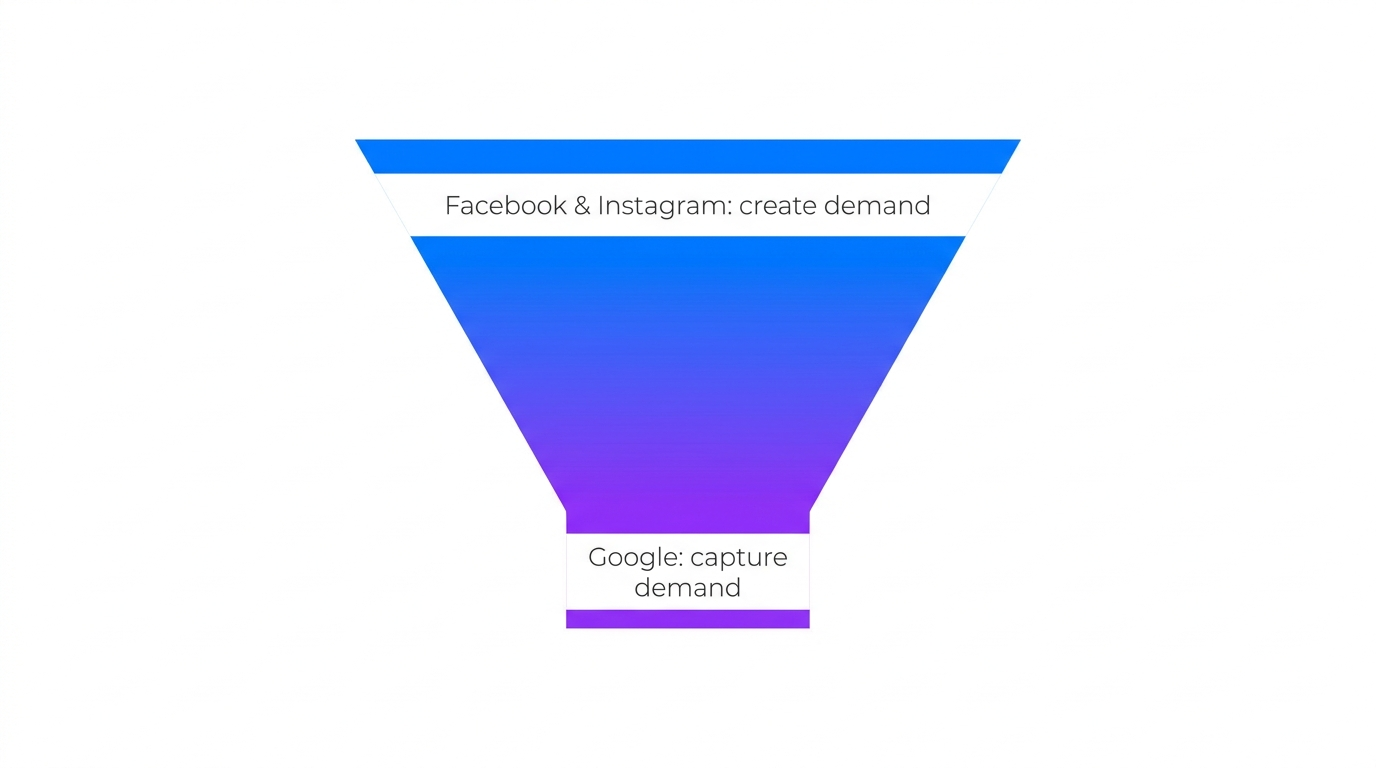
Google and Facebook are not rivals. They are two halves of one funnel. Meta creates demand at the top - people discover you, watch a video, visit your site. Google and retargeting close that demand at the bottom - when those same people later search your name or your service, you are there. Run Meta to fill the funnel, Google to catch what falls out of it, and retargeting to sweep up the near-misses on both.
The mistake is not choosing the "wrong" platform. It is running them as two disconnected experiments instead of one system, so neither gets the follow-up that turns a click into a customer. That connective tissue - fast lead follow-up, retargeting, and tracking what actually became a sale - is where campaigns quietly win or lose. We cover the follow-up half in AI marketing automation for local business, and what a good ROAS actually is covers how to judge the result once both are running.
How AdForce runs paid ads
We do not pick a platform and hope. We start from your goal - calls, bookings, or awareness - map the funnel, and put each dollar where it does the most work: Google Ads to capture demand, Meta Ads to create it, and tracking that ties spend to real leads instead of vanity clicks. Real people own the strategy; the best AI handles the optimization in between. If you want us to look at your numbers and tell you honestly where your first (or next) dollar should go, book a free 15-minute call.
Frequently asked questions
Is it better to advertise on Google or Facebook?
It depends on your goal. Choose Google Ads when you need to capture existing demand - people actively searching for what you sell - which is the fastest route to calls and bookings. Choose Facebook and Instagram Ads when you need to build awareness, launch something new, or reach people who fit your customer profile but are not searching yet. Many businesses eventually run both.
Which is cheaper, Google Ads or Facebook Ads?
Facebook and Instagram usually have a lower cost per click and cheaper reach, while Google clicks tend to cost more because they come from high-intent searches. But cheaper clicks are not the same as cheaper customers. The platform that wins is the one with the lower cost per booked job, so always judge by cost per lead and cost per sale, not cost per click.
Can I run Google Ads and Facebook Ads at the same time?
Yes, and for many businesses that is the strongest setup. Facebook and Instagram create demand at the top of the funnel, Google captures it at the bottom when people search, and retargeting closes the near-misses. The key is running them as one connected system with proper follow-up, not two disconnected experiments.
How much should a small business budget for paid ads?
There is no fixed number, but the right way to set a budget is against the value of a customer. If one new job is worth thousands and ads reliably bring several a month at a healthy cost per sale, you scale up. Start small, prove the cost per lead on one platform, then expand once the math works.
Why are my Facebook ads getting clicks but no sales?
Usually because Facebook clicks come from discovery, not active buying intent, so they need more nurturing than a Google search click. The fix is stronger creative, retargeting, and above all fast, consistent follow-up on the leads you do get. Clicks that never get a timely call rarely become customers.
Do I still need Google Ads if I rank well in local SEO?
Often yes, at least for the searches that matter most. Local SEO earns the free spots over time, while Google Ads lets you own the very top of the page immediately and for specific high-value or time-sensitive searches. Running both means you occupy more of the results page for the queries that bring you customers.