How to Improve ROI in Digital Marketing (2026): Stop the Leaks After the Click
Quick answer: Marketing ROI is (revenue from marketing minus marketing cost) divided by marketing cost, times 100; a 5:1 return is a healthy benchmark. But most lost ROI happens after the click, not inside the ad account. The fastest gains come from tracking every lead to actual revenue, responding to leads in minutes, retargeting the traffic you already paid for, shifting budget to proven winners, and building owned channels like SEO and email that compound over time.
Published 2026-07-07 · Guides · by AdForce

You are staring at your ad dashboard, and the numbers look fine. Clicks are up, the cost per click dropped, your click-through rate is the best it has been all year. And yet the bank account has not moved. This is the quiet frustration behind almost every "how do I improve my marketing ROI" question, and the honest answer surprises most owners: the problem is rarely inside the ad account at all.
Let's define the term first, because a lot of bad decisions come from a fuzzy one. Marketing ROI is simply how much profit each marketing dollar returns. The formula has not changed in decades:
(Revenue from marketing - Marketing cost) / Marketing cost x 100
Spend 2,000 dollars, generate 10,000 dollars in tracked revenue, and your ROI is (10,000 - 2,000) / 2,000, which is 400 percent, or a 5:1 return. A 5:1 ratio is the common benchmark for "healthy." Around 10:1 is exceptional. Below roughly 2:1 you are often just moving money around. Those are useful goalposts, but notice what the formula quietly demands: you need to know the real revenue a campaign produced, not the clicks it bought. That single requirement is where most businesses fall apart.
The reframe: your ROI leaks after the click, not before it
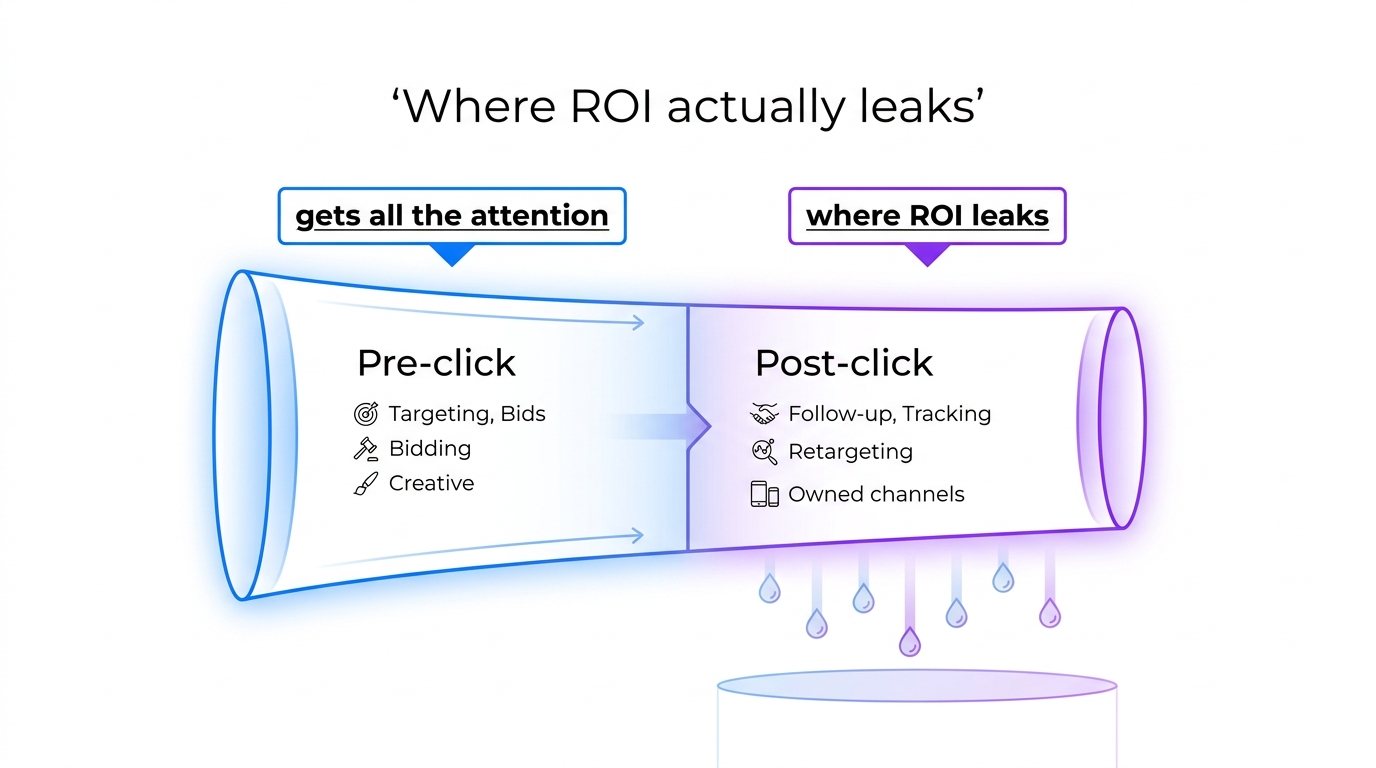
Here is the shift that changes how you spend for good. Most lost ROI happens after someone clicks your ad, not inside the ad platform. Owners pour weeks into lowering their cost per click by a few cents while a lead they already paid for sits in an inbox for six hours, goes cold, and buys from the competitor who called back first. You optimized the cheap part of the funnel and ignored the expensive one.
Think of it as two halves. The pre-click half is the ad account: targeting, bids, keywords, creative. It gets almost all the attention because it has a shiny dashboard. The post-click half is everything that turns attention into money: your follow-up speed, your landing page, your tracking, your retargeting, and whether you actually double down on what worked. That half usually has no dashboard, so it stays invisible, and invisible things do not get fixed.
Step one: track to revenue, not vanity metrics
You cannot improve a return you cannot see. Impressions, likes, clicks, and even cost per click are inputs, not outcomes. They tell you the ad is running, not that it is making you money. The businesses with the best ROI are not the ones with the cleverest ads; they are the ones who can trace a dollar of spend to a booked job.
That means connecting the dots from ad to lead to sale. At minimum: conversion tracking on every form and call, a way to see which channel produced each lead, and a simple record of which of those leads actually paid. When a plumber tells us "Google Ads doesn't work," we almost always find the campaign was generating calls that nobody was tagging as revenue. The ads were fine. The measurement was blind. If your click-to-customer path is murky, our guide on PPC conversion rate walks through the tracking that makes the rest of this possible.
Step two: speed-to-lead is the highest-ROI fix nobody budgets for
This is the leak that costs the most and shows up on no ad report. Studies of inbound sales have found that contacting a new lead within five minutes makes you many times more likely to qualify them than waiting even thirty minutes, and the odds fall off a cliff after the first hour. Most small businesses reply in hours, if at all, especially to after-hours and weekend inquiries.
Do the math on your own numbers. If you spend 3,000 dollars a month on ads to generate 60 leads and half of them go cold before anyone follows up, you did not pay for 60 leads. You paid the same 3,000 dollars for 30. Cutting your response time from four hours to four minutes can double the return on spend you already committed, without touching a single bid. This is why we tell people the cheapest ROI win available to them is faster follow-up, usually through an AI agent that answers and books leads instantly, day or night.
Step three: retarget the warm traffic you already paid for
The vast majority of people who click an ad or visit your site do not convert on the first visit. That is normal. What is wasteful is treating that first visit as your only shot. You already paid to earn their attention; retargeting is how you finish the job for pennies on the dollar.
Warm audiences, people who visited a service page, watched most of a video, or abandoned a form, convert at a far higher rate than cold traffic because they already know who you are. A modest retargeting budget aimed at those visitors is frequently the single highest-ROI line in the whole plan. If you are spending to fill the top of the funnel with Google Ads or paid social but running no retargeting, you are pouring water into a bucket with the drain wide open.
Step four: double down on what works, cut what does not
Marketing budgets tend to get spread evenly, like everyone gets a fair slice. Returns do not work that way. In most accounts a small fraction of campaigns, keywords, or audiences drives the majority of the profitable revenue, and a long tail quietly loses money. Even, "fair" budgeting is how you subsidize your losers with your winners.
Once your tracking is honest (step one), this becomes obvious. Find the two or three things producing sales at a healthy cost per acquisition, and move budget into them. Pause or rework the ones that generate clicks but no customers. This is not a one-time cleanup; it is a monthly habit. The compounding effect of consistently feeding winners and starving losers is larger than almost any clever tactic.
Where your ROI actually leaks, and what to do about it
| Funnel stage | Common leak | The fix | Typical impact |
|---|---|---|---|
| Measurement | Judging ads on clicks and CPC, not sales | Track every lead to revenue by channel | Reveals which spend to cut vs scale |
| Speed-to-lead | Hours-long or no follow-up | Reply in minutes, automate after-hours | Can double return on existing spend |
| Warm traffic | No retargeting of past visitors | Retarget site and video audiences | High-ROI, low-cost conversions |
| Budget mix | Spread evenly across everything | Shift money to proven winners | Compounds monthly |
| Channel mix | Renting all your reach with ads | Build owned SEO, GEO, and email | ROI that grows after you stop paying |
Step five: build owned channels that compound
Paid ads are rented reach. The moment you stop paying, the leads stop. That is fine, ads are the fastest way to create demand this month, but a plan built only on ads has an ROI ceiling because your cost per lead never really drops, and that ceiling sits exactly where your break-even ROAS puts it. Owned channels are the opposite. They cost effort up front and then keep returning for years.
Local SEO and its AI-era cousin, showing up when people ask ChatGPT or Google's AI for a recommendation, are the clearest example. A page that ranks brings you leads every month at no additional cost per click, so your blended cost per lead falls as it matures. Email is the same story: a list you own converts warm buyers at a fraction of the cost of acquiring a stranger. The smart pattern is to run paid ads for cash flow now, while SEO, GEO, and email build underneath, so this year's spend keeps paying you next year. That is what "compounding ROI" actually means, and it is why the highest-ROI businesses look boring: they do the durable work while everyone else chases the next cheap click. The catch is that compounding needs a runway, so it helps to know how long SEO actually takes before you judge it.
Putting it together
Improving marketing ROI is less about finding a secret channel and more about plugging the leaks in the funnel you already run. Measure to revenue so you know the truth. Answer leads in minutes so you stop paying for cold ones. Retarget the traffic you already bought. Feed your winners and cut your losers every month. And build owned channels so your returns compound instead of resetting to zero every billing cycle. None of that requires a bigger budget. It requires spending the budget you have where it actually turns into customers.
If you want a second set of eyes on where your return is leaking, that is exactly the audit we do first. We trace your spend to real sales, find the biggest post-click leak, and tell you honestly whether the fix is your ads or everything after them. Book a free 15-minute call and we will look at your numbers with you.
Frequently asked questions
How do you calculate marketing ROI?
Use the formula (Revenue from marketing - Marketing cost) / Marketing cost x 100. For example, if you spend 2,000 dollars and it generates 10,000 dollars in tracked revenue, your ROI is (10,000 - 2,000) / 2,000, which equals 400 percent, or a 5:1 return. The hard part is not the math, it is accurately tracking the revenue each campaign produced rather than just the clicks it bought.
What is a good ROI for digital marketing?
A 5:1 ratio, five dollars back for every dollar spent, is the common benchmark for a healthy return. Around 10:1 is considered exceptional, and below roughly 2:1 you are often barely breaking even once you account for time and overhead. Targets vary by industry and margin, so the more useful question is whether your ROI is trending up as you fix leaks in your funnel.
Why is my marketing ROI low even though I get lots of clicks?
Clicks are an input, not a result. Low ROI with high clicks almost always means the loss is happening after the click: slow or missing lead follow-up, a weak landing page, no retargeting, or no tracking that ties spend to actual sales. Owners tend to optimize the cheap pre-click half of the funnel while the expensive post-click half quietly leaks the return.
What is speed-to-lead and why does it matter for ROI?
Speed-to-lead is how fast you respond to a new inquiry. It matters enormously because studies of inbound sales find you are far more likely to qualify a lead if you contact them within five minutes versus even thirty, and the odds drop sharply after the first hour. Since you already paid to generate the lead, replying faster can double the return on spend you have already committed without changing a single bid.
Does retargeting actually improve ROI?
Usually yes, and it is often the highest-ROI line in the plan. Most people do not convert on their first visit, so retargeting lets you finish the sale with people who already know you, at a much lower cost than acquiring cold traffic. If you spend to bring visitors to your site but run no retargeting, you are paying for attention and then letting it walk away.
Which digital marketing channel has the highest ROI?
Over time, owned channels like SEO, GEO (showing up in AI answers), and email tend to have the highest ROI because they keep returning leads without a per-click cost, so your blended cost per lead falls as they mature. Paid ads deliver the fastest ROI right now but reset to zero when you stop paying. The strongest approach runs ads for immediate cash flow while owned channels compound underneath.
How can I improve ROI without increasing my budget?
Focus on the post-click leaks, which cost nothing extra to fix. Track every lead to revenue so you know what to cut and what to scale, respond to leads in minutes instead of hours, retarget visitors you already paid for, and shift budget from underperforming campaigns into the proven winners. These moves raise the return on the exact same spend.
How long does it take to see better marketing ROI?
Post-click fixes like faster follow-up and retargeting can lift returns within weeks because you are converting more of the leads you already generate. Owned channels like SEO and content take longer, often a few months, but they compound and lower your cost per lead over time. A good plan pairs the quick post-click wins with the slower durable ones.