How to Calculate and Improve Your PPC Conversion Rate (2026)
Quick answer: Your PPC conversion rate is conversions divided by clicks, times 100. If 5 of 100 clicks convert, that is 5 percent. A good rate depends on your industry, roughly 3 to 6 percent for Google Search and higher for urgent local services, but the real leverage is not the ad. Fixing your landing page and follow-up speed lifts the rate, and a higher conversion rate is far cheaper than buying more clicks.
Published 2026-07-07 · Paid Ads · by AdForce

You are staring at a campaign that is spending money and generating clicks, and yet the phone is not ringing the way the click count says it should. The instinct is to blame the ad, or the keyword, or Google. Usually the real answer is quieter and more fixable: your conversion rate. It is the single number that tells you whether all that traffic is turning into actual business, and it is the number most owners never look at closely enough.
Here is the good news up front. A higher conversion rate is the cheapest growth you can buy. More clicks cost more money every single time. Lifting the rate at which your existing clicks turn into leads costs you almost nothing extra, and it compounds across every dollar you will ever spend. That is the whole game, and the rest of this guide shows you how to play it.
What is a PPC conversion rate, exactly?
PPC stands for pay-per-click, the model where you pay each time someone clicks your ad on Google, Meta, or anywhere else. Your conversion rate measures how many of those paid clicks go on to do the thing you actually wanted: request a quote, book a call, buy, or fill out a form.
It is not a vanity metric. It is the bridge between spending money and making money. Two businesses can run the identical ad, pay the identical cost per click, and one quietly outperforms the other by three to one purely because more of their clicks convert. The ad got them equal traffic. The conversion rate decided who got the customers.
How do you calculate your PPC conversion rate?
The formula is deliberately simple:
Conversion Rate = (Conversions / Clicks) x 100
If 100 people clicked your ad and 5 of them filled out your form, that is (5 / 100) x 100 = 5 percent. That is it. No calculator or spreadsheet gymnastics required.
The part people get wrong is not the math, it is deciding what counts as a conversion. Before the number means anything, you have to define the action that matters to your business and track it honestly:
- Pick one primary conversion. For most local and service businesses that is a call, a booked appointment, or a submitted quote request. Not a page view, not a click to a second page. The thing that puts a real lead in front of you.
- Set up conversion tracking properly in Google Ads and your analytics, or the tag that fires when the form submits. If tracking is sloppy, every decision downstream is built on sand.
- Watch the same definition over time. Changing what you count mid-stream makes your trend line lie to you.
Get those three right and your conversion rate becomes the most trustworthy dial on your dashboard.
What is a good conversion rate for PPC?
The honest answer is the one nobody likes: it depends. It swings with your industry, your offer, your price point, and how much research a buyer does before they commit. A conversion rate that would be spectacular for a custom home builder would be a disaster for a cheap impulse purchase.
That said, you deserve real numbers rather than a shrug. Here are honest ranges to orient yourself, not targets to obsess over.
| Scenario | Rough conversion rate | Why |
|---|---|---|
| Google Search, all industries | 3 to 6 percent | High-intent clicks, people already looking |
| Google Display / awareness | Under 1 percent | Interruptive, low intent |
| High-consideration services (real estate, legal) | 2 to 5 percent | Big decisions, longer research |
| Local trades and home services | 8 to 15 percent | Urgent, "near me" demand converts fast |
| E-commerce / Shopping | 2 to 4 percent | Comparison shopping, cart abandonment |
Use these as a sanity check, not a scoreboard. If you are a plumber sitting at 3 percent on high-intent search clicks, something is leaking. If you are a law firm at 4 percent, you may be doing fine and should focus on lead quality instead. The only benchmark that truly matters is your own last quarter. Beating yourself is the whole job.
The reframe: a higher conversion rate is cheaper than more clicks
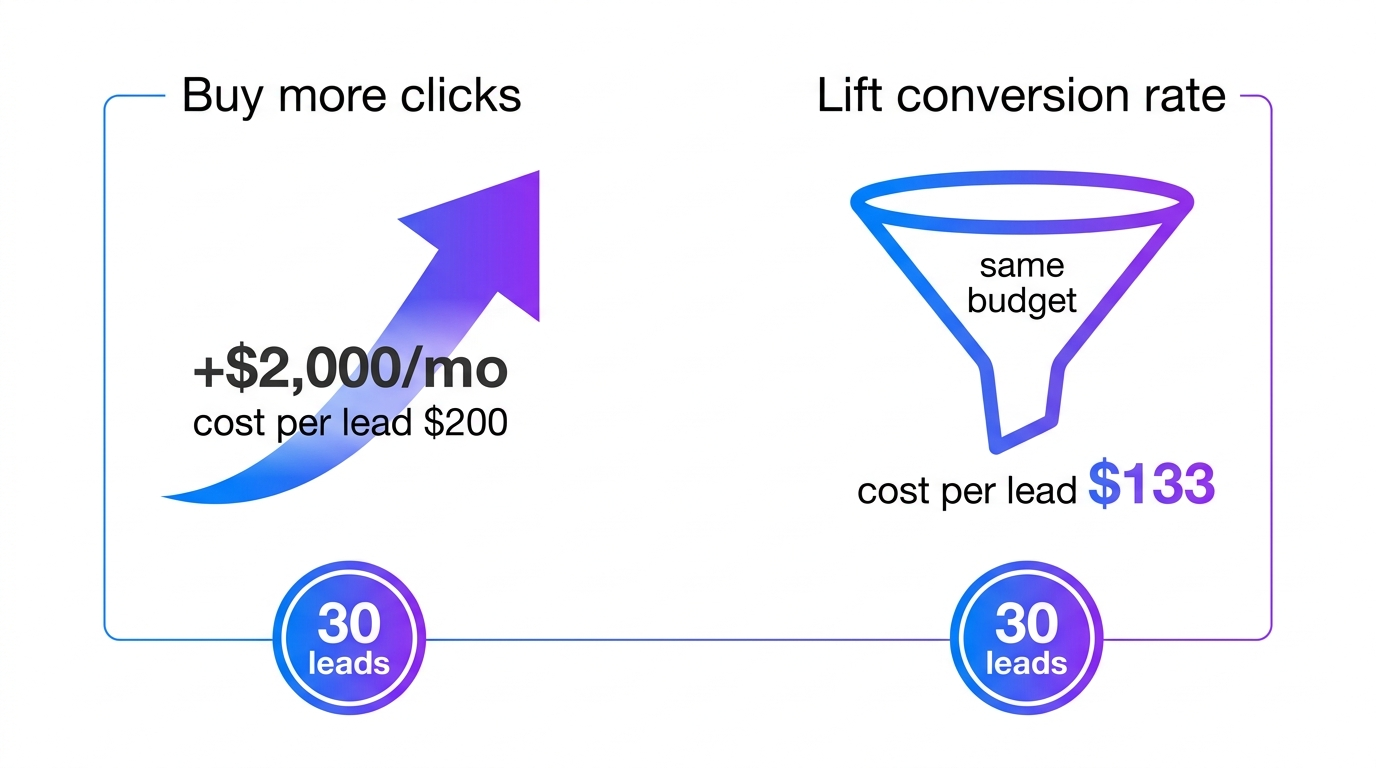
This is the insight that changes how you spend. Most owners, when they want more leads, reach for the same lever: buy more clicks. Raise the budget, widen the keywords, turn up the volume. It works, but it is the most expensive way to grow, because every extra lead costs you full price forever.
Now look at what happens when you improve the conversion rate instead of the traffic.
| Buy more clicks | Lift conversion rate | |
|---|---|---|
| Monthly clicks | 500 to 750 | 500 (unchanged) |
| Cost per click | $8 | $8 |
| Conversion rate | 4 percent | 4 to 6 percent |
| Monthly ad spend | $4,000 to $6,000 | $4,000 (unchanged) |
| Leads per month | 20 to 30 | 20 to 30 |
| Cost per lead | $200 | $133 |
Both paths get you from 20 leads to 30. One of them costs an extra $2,000 a month, every month, forever. The other costs a one-time improvement to your landing page and your follow-up, and then keeps paying you back on every future dollar. Same result, radically different economics. This is why we tell clients to fix conversion before scaling spend. Pouring more budget into a leaky funnel just buys you more expensive leaks.
Where conversions are actually won: the page and the follow-up
Owners spend weeks fiddling with ad copy and keywords, then send every hard-won click to a slow, generic homepage and never call the leads back fast enough. The ad is rarely the bottleneck. The click already happened. What you do in the ninety seconds after the click is where money is made or lost.
There are two levers, and they are the ones almost everyone under-invests in. The first is the landing page, which decides whether a click becomes a lead. The second is your follow-up speed, which decides whether that lead becomes a customer. If you only fix one thing after reading this, make it one of these two.
A concrete checklist to improve your PPC conversion rate
Work down this list in order. The early items move the needle far more than the clever stuff near the bottom.
1. Nail message match. The headline on your landing page should echo the promise in the ad the person just clicked. If your ad said "24-hour emergency plumbing" and the page opens with "Welcome to our family business since 1998," you just broke the promise and lost the click. Match the words, match the offer, match the intent.
2. Make the page fast. A page that takes four seconds to load has already lost a chunk of mobile visitors before they see a word. Compress images, cut heavy scripts, and test on a real phone on cellular data. Speed is not a technical nicety, it is conversion rate.
3. One page, one clear call to action. Every landing page should ask for exactly one thing. Call now, or book, or get a quote. When you offer five options you get decision paralysis and fewer of all of them. Remove the navigation, remove the distractions, and repeat the one action you want.
4. Cut your form fields. Every field you ask for costs you conversions. Name, phone, and one line about the job is usually enough to start a real conversation. You can qualify further once they are a live lead. Asking for a fax number in 2026 is how you watch people bounce.
5. Fix speed-to-lead follow-up. This is the highest-leverage item on the entire list and the one most businesses ignore. The odds of connecting with a lead fall off a cliff after the first few minutes. A five-minute callback is a different business than a five-hour one. Automating that instant first response is exactly what our AI marketing automation for local business approach is built to solve, because no human is fast enough every time, around the clock.
6. Then, and only then, tune the ad side. Once the page and follow-up are tight, tighten your keywords to match real buyer intent and sharpen your ad copy so the clicks you pay for are the right clicks in the first place. Good conversion optimization starts by sending better traffic, not just converting whatever shows up. This is where a well-run Google Ads account earns its keep.
Notice the order. Message match, speed, and follow-up come before A/B testing button colors. Test the small stuff after the big leaks are sealed, not instead of.
A quick word on which platform you are optimizing
Conversion rates read very differently across platforms, and comparing them straight is a trap. A Google search click comes from someone actively hunting, so it converts fast. A Meta click comes from someone scrolling who was not looking for you, so it needs more nurturing before it turns into a sale. If your Facebook conversion rate looks low next to Google, that is often the medium, not a failure. We break down that intent-versus-discovery split in Google Ads vs Facebook Ads, and it is worth understanding before you judge any single number too harshly.
The broader point is that conversion rate is one input into the number that actually pays your bills: return on ad spend. Before you decide whether yours is healthy, work out what a good ROAS is for your margin, because the break-even point is different for every business. If you want the full picture of how these metrics connect to profit, our guide on how to improve your marketing ROI ties it together.
How AdForce approaches conversion rate
We do not start by adding budget. We start by finding the leak. That usually means tightening the landing page so the click becomes a lead, and wiring up instant follow-up so the lead becomes a customer, before we touch the traffic dial. Real people own the strategy, and the best AI handles the relentless optimization and the instant first response in between. The result is that your existing spend simply works harder.
If you want us to look at your actual numbers and tell you honestly where your conversion rate is leaking and what it is costing you, book a free 15-minute call. We will show you the math before we ever ask you to spend a dollar more.
Frequently asked questions
How do I calculate my PPC conversion rate?
Divide your number of conversions by your number of clicks, then multiply by 100. For example, 5 conversions from 100 clicks is (5 / 100) x 100, which equals a 5 percent conversion rate. The only tricky part is deciding what counts as a conversion, so pick one meaningful action like a call, booking, or submitted quote, and track it consistently.
What is a good conversion rate for PPC?
It depends heavily on your industry and offer, but a rough guide is 3 to 6 percent for Google Search across most industries, 2 to 5 percent for high-consideration services like real estate and legal, and 8 to 15 percent for urgent local trades and home services. The most useful benchmark is your own past performance. Beating last quarter matters more than matching an industry average.
Why is a higher conversion rate cheaper than getting more clicks?
Every additional click costs you money every single time you buy it. Lifting your conversion rate makes your existing clicks produce more leads at no extra media cost, and that improvement keeps paying off on every future dollar you spend. Going from a 4 percent to a 6 percent conversion rate can cut your cost per lead by a third without raising your ad budget at all.
What has more impact on conversions, the ad or the landing page?
Usually the landing page and your follow-up, not the ad. By the time someone clicks, the ad has already done its job. The landing page decides whether that click becomes a lead, and how fast you follow up decides whether that lead becomes a customer. Most businesses over-invest in ad tweaks and under-invest in these two levers.
How can I improve my PPC conversion rate quickly?
Start with message match so your landing page headline echoes the ad that was clicked, make the page load fast on mobile, give the page one clear call to action, and cut your form down to the few fields you truly need. Then fix your follow-up speed so new leads get a response within minutes, not hours. Those changes move the needle far more than testing button colors.
What is speed-to-lead and why does it affect conversion rate?
Speed-to-lead is how fast you respond to a new inquiry. The odds of connecting with a lead drop sharply after the first few minutes, so a five-minute callback converts far better than a five-hour one. Since no team can respond instantly every time around the clock, automating that first response is one of the highest-leverage conversion improvements available.
Do Google and Facebook conversion rates compare directly?
No, and comparing them straight is misleading. Google search clicks come from people actively searching, so they convert quickly. Facebook and Instagram clicks come from people scrolling who were not looking for you, so they need more nurturing before converting. A lower Meta conversion rate is often the nature of the medium rather than a failure of the campaign.
Should I improve my conversion rate before increasing my ad budget?
Almost always yes. Adding budget to a funnel that leaks just buys you more expensive leaks. Tighten your landing page and follow-up so more of your current clicks convert, then scale the traffic once the math works. Fixing conversion first lowers your cost per lead permanently, and that lower cost applies to every extra dollar you spend afterward.