Local SEO for Local Businesses: The 2026 Guide to the Map Pack, Reviews, and Getting Found
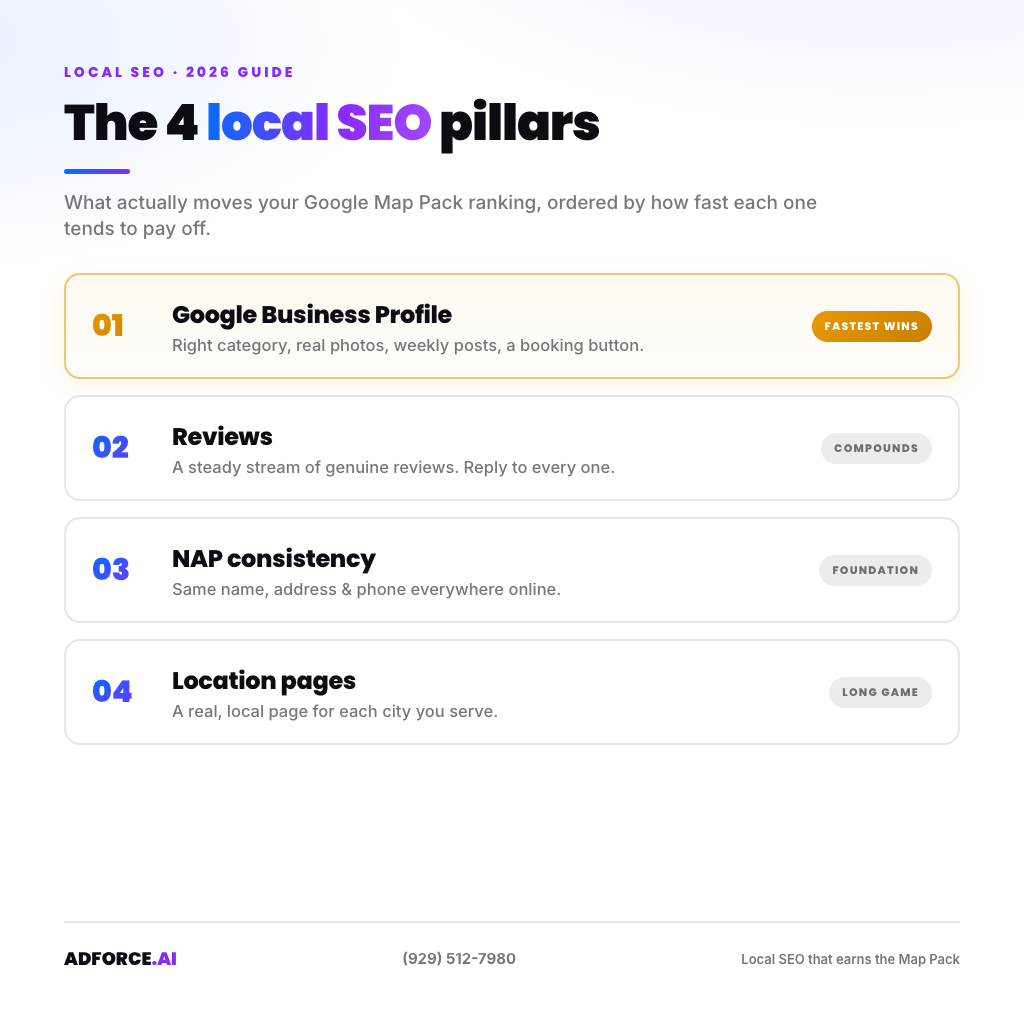
Quick answer: Local SEO is how a service-area or storefront business gets found by people nearby who are ready to buy. In 2026 it comes down to four things: a fully optimized Google Business Profile, a steady stream of genuine reviews, consistent business information (NAP) across the web, and location-specific pages on your site. Get those right and you compete for the Map Pack - the three local results that sit above the regular links and capture most of the clicks.
Published 2026-06-16 · Local SEO · by AdForce

You typed your own business into Google last week and felt your stomach drop. A competitor you have never heard of sits in the top three with a glowing row of stars, and you are nowhere on the first screen. The good news: the Map Pack is not a popularity contest you already lost. It is a set of signals you can influence, and most of your competitors are doing the bare minimum.
There is no single magic switch. But there is a short list of things that actually move local rankings, and a much longer list of things agencies sell you that do not. This guide is the short list - what to do, in what order, and roughly what it is worth.
What "local SEO" actually means in 2026
Local SEO is the practice of getting your business to show up when someone nearby searches for what you sell. Three surfaces matter:
- The Map Pack - the boxed set of three local businesses with a map, ratings, and a "Directions" button. It sits above the regular blue links and takes the lion's share of clicks for local searches.
- The classic organic results - the standard links below the map. Your website ranks here.
- AI answers - increasingly, people ask ChatGPT, Gemini, or Google's AI Overview "who's the best plumber near me?" and act on the names those tools return. That is a new front, and it shares a foundation with everything below. We cover it in our guide on how to get recommended by ChatGPT.
The reframe most owners miss: the Map Pack and your website are ranked by different things. Your website ranks on content, links, and technical health. The Map Pack ranks mostly on your Google Business Profile, proximity, and reviews. You have to work both, but the Profile is where local businesses get the fastest wins.
The 4 pillars that move local rankings
1. Google Business Profile (your single highest-leverage asset)
Your Google Business Profile is the listing behind the Map Pack. Treat it like a landing page, not a phone-book entry:
- Primary category - pick the most specific one that fits ("Emergency Plumber", not just "Plumber"). This single field has an outsized effect on what you rank for, and it is the first thing we check when a profile is not ranking on Google Maps.
- Services and service areas - list every service with a short description, and define the cities or zip codes you cover.
- Photos - real, recent photos of your team, work, and storefront. Profiles with fresh photos get more calls and direction requests.
- Hours, phone, website, booking link - accurate and complete. A booking or "message" button removes friction at the exact moment of intent.
- Google Posts - weekly updates (offers, jobs completed, FAQs). They signal an active, real business.
2. Reviews (the trust signal that compounds)
Reviews influence both ranking and conversion. The math is simple: more recent, higher-rated reviews mean more Map-Pack visibility and more people choosing you once they see it.
- Ask every happy customer, every time, with a direct link to your review form.
- Reply to all of them - positive and negative. A calm, specific reply to a bad review converts the next reader better than a wall of five stars with no responses.
- Aim for a steady drip, not a one-time blast. Twenty reviews over six months beats forty in one week. Review velocity is also one of the fastest-moving signals you control, which is why it shows up early in any realistic SEO timeline.
3. NAP consistency and citations
NAP stands for Name, Address, Phone. Google cross-checks your details across directories (Yelp, Bing Places, Apple Maps, industry sites). When they disagree, Google trusts you less. Pick one exact format and make it identical everywhere. Clean this up once and it pays off quietly for years.
4. Location pages on your website
If you serve multiple cities, build a real page for each - "Bathroom Remodeling in Oakland", not a thin doorway page. Each page should have genuinely local content: neighborhoods served, local projects, area-specific FAQs. These are what let you rank organically for "city + service" searches that the Map Pack alone will not cover. The same content discipline that powers a good location page also feeds AI search, which is why we usually build them once and use them everywhere. A well-built website makes this far easier.
Real math: doing it yourself vs. hiring it out
Local SEO is not free even when you do it yourself - it costs your time, which is the most expensive thing a busy owner has. Here is an honest comparison for a typical local service business.
| Do it yourself | Hire AdForce | |
|---|---|---|
| Up-front setup | 20-40 hours of your time | Done for you in the first weeks |
| Monthly effort | 5-10 hours/month, forever | A few minutes to approve posts |
| Tools (rank tracking, citations) | $50-200/mo you buy | Included |
| Typical time to Map-Pack movement | Slower (learning curve) | Faster (proven playbook) |
| Risk | Easy to stall after month two | Accountable to results |
The honest part: if you are early, have time, and only serve one city, you can absolutely do the basics yourself, and you should not pay anyone until you have claimed your Profile and asked for reviews. Where an agency earns its fee is consistency at scale - multiple locations, ongoing content, review systems, and the technical work that quietly stops your rankings from slipping. If a "done in 30 days, guaranteed #1" pitch lands in your inbox, delete it. Nobody can guarantee a Google ranking.
What does NOT move the needle (stop paying for these)
- Keyword-stuffed business names. Adding "Best Cheap Emergency" to your Google name violates the guidelines and can get you suspended.
- Buying reviews. Detectable, against policy, and it poisons the trust you are trying to build.
- Mass low-quality directory submissions. A hundred junk citations do nothing. A handful of accurate, relevant ones do.
- Blogging with no local intent. Generic posts that never mention your service area do not help you rank locally.
How AdForce runs local SEO
If you are in a trade, the vertical versions of this are SEO for roofers and SEO for contractors, and how much local SEO costs sets out the price bands and what each one buys before you talk to anyone. Our Local SEO service handles the whole loop: Profile optimization, a review-generation system, citation cleanup, location pages, and monthly reporting that ties the work to calls and form fills - not vanity rankings. Because the content and schema we build also feed AI engines, your local SEO investment increasingly pays off in AI search too. And when you are ready to add paid acceleration on top, Google Ads and local service ads slot in cleanly. If you want the fastest path mapped for your exact situation, book a free 15-minute call.
Frequently asked questions
How long does local SEO take to work?
Profile and review improvements can lift Map-Pack visibility within weeks. Organic rankings for competitive "city + service" terms usually take a few months because they depend on content and authority that compound over time. Anyone promising guaranteed #1 in 30 days is selling you something Google does not allow them to deliver.
What is the Google Map Pack?
It is the boxed set of three local businesses, with a map and ratings, that appears above the regular search links for local queries. It captures most of the clicks for "near me" and local-intent searches, which is why ranking there is the core goal of local SEO.
Do reviews really affect my Google ranking?
Yes. The quantity, recency, rating, and even the keywords in your reviews are signals Google uses for the Map Pack, and they strongly affect whether someone chooses you once they see your listing. A steady stream of genuine reviews is one of the highest-leverage things a local business can do.
What is NAP consistency and why does it matter?
NAP stands for Name, Address, Phone. When those details match exactly across Google, Yelp, Apple Maps, and other directories, Google trusts your business more. Inconsistent listings create doubt and can suppress your local rankings.
Can I do local SEO myself or do I need an agency?
You can do the basics yourself: claim and complete your Google Business Profile, ask happy customers for reviews, and keep your information consistent. An agency earns its fee on consistency and scale, especially across multiple locations, ongoing content, and the technical work that keeps rankings from slipping.
Does local SEO help me show up in ChatGPT and AI search?
Increasingly, yes. The same accurate listings, structured data, and answer-ready content that power local SEO also make AI engines more likely to recommend you. We treat them as one connected foundation rather than separate projects.
How much should a local business spend on SEO?
It varies by competition and number of locations, but the right way to judge spend is against the value of a new customer. If one new job is worth thousands and SEO reliably brings several a month, the math is straightforward. Start with the free fundamentals before paying for anything.