How to Get Your Business Recommended by ChatGPT (A Practical GEO Guide)
Quick answer: To get recommended by ChatGPT: (1) publish clear, quotable content that directly answers the questions buyers ask, (2) add structured data (FAQ, organization, product schema) so models can parse your facts, (3) build consistent entity signals - accurate listings, reviews, and citations across the web, and (4) track your AI visibility and iterate. AI recommends sources it can understand and trust, so GEO is about being the clearest, most consistent, best-corroborated answer to the question your customer is actually asking.
Published 2026-06-01, updated 2026-06-16 · GEO & SEO · by AdForce

You asked ChatGPT to recommend a business in your industry and your stomach turned: it named three competitors and not you. You are not behind on Google - you are invisible on the surface where a growing number of buyers now start. That is the gap GEO closes.
Generative Engine Optimization (GEO) is the practice of making your brand easy for AI answer engines to understand, trust, and cite. It is the new "ranking #1," and because it is early, the businesses that move now get an outsized head start. If you want the difference between this and classic search spelled out, start with GEO vs SEO.
Why this matters now
When someone asks ChatGPT, Perplexity, or Google's AI Overview "who's the best remodeler in Miami?", the model returns a short list - and most people act on it without scrolling further. If your business is not in that answer, the customer never even reaches your beautifully optimized website. AI is becoming the front door, and GEO is how you get listed at the door.
The reframe: you cannot control the model, but you can strongly influence it. Models lean on sources that are clear, structured, and corroborated across the web. That is all stuff you can build.
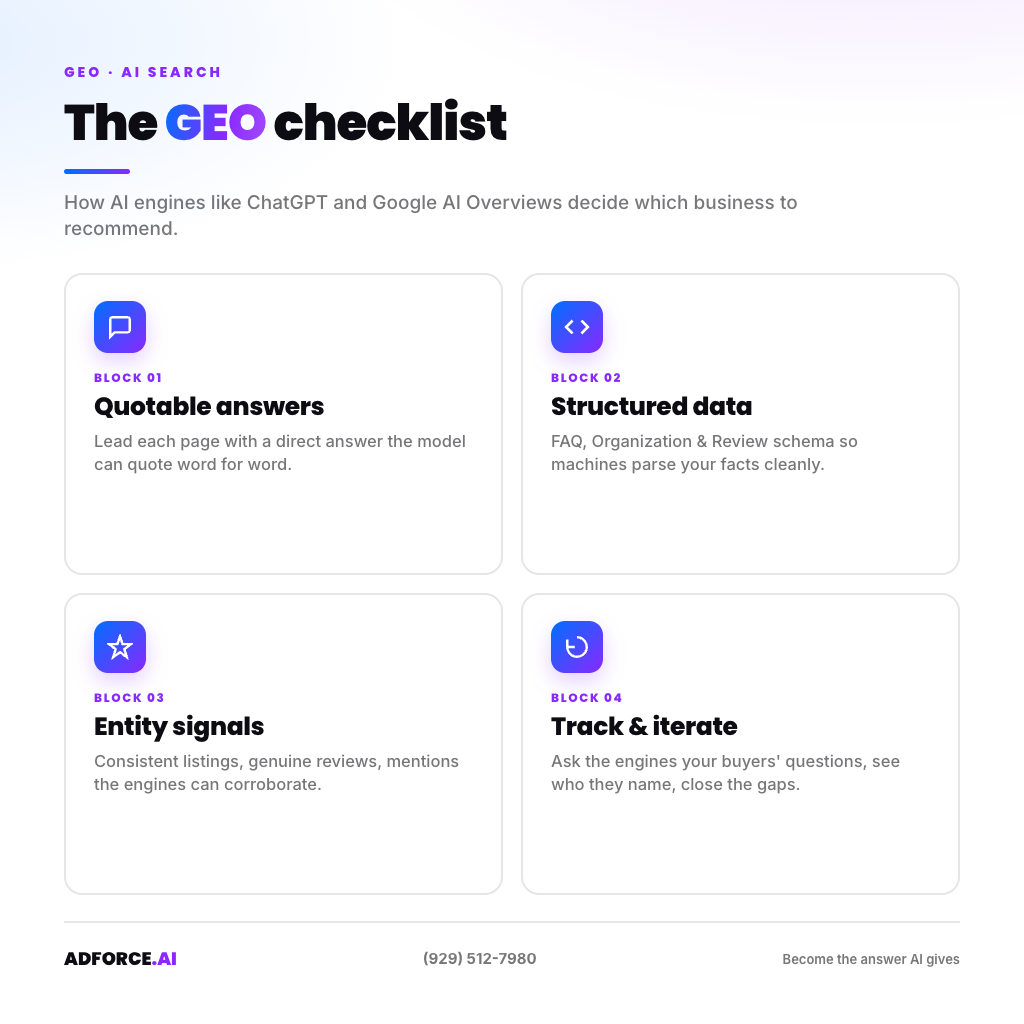
The GEO playbook (4 steps)
1. Answer the real questions, quotably
Models lift sentences that cleanly answer a question. Structure pages around the actual prompts buyers use - "best X in [city]", "how much does Y cost", "is Z worth it" - and lead each with a direct, self-contained answer the model can quote without rewriting. The "Quick answer" box at the top of this very article is an example of the pattern.
2. Make your facts machine-readable
Add schema markup - Organization, FAQ, Product or Service, and Review - so engines can extract your name, services, location, and proof without guessing. Clean structured data is one of the strongest and most overlooked GEO signals. It is also why our AI search service treats schema as foundational, not optional.
3. Build entity authority
AI trusts entities it sees described consistently across the web: accurate business listings, genuine reviews, mentions on reputable sites, and a clear, factual "about" presence. This is the same consistency work that powers local SEO - which is exactly why the two compound when you do them together. Inconsistent or thin information makes models hesitant to name you.
4. Track and iterate
Ask the major engines the questions your customers ask, record whether you are mentioned and whether the facts are right, then close the gaps. GEO is measurable - treat it like a loop, not a one-time fix.
Real example: two businesses, same service
Picture two remodelers in the same city. Both have decent websites. One has done the GEO work.
| Business A (no GEO) | Business B (GEO done) | |
|---|---|---|
| Answer-ready content | Generic service pages | Pages built around real buyer questions |
| Structured data | None | Organization + FAQ + Review schema |
| Listings and reviews | Inconsistent, thin | Consistent, steady, corroborated |
| Result in AI answers | Rarely named | Frequently named and cited |
Same service, same city. The difference in whether AI recommends them is not luck - it is the work. And the honest part: GEO will not invent a reputation you have not earned. If your reviews are poor and your information is contradictory, the right move is to fix those first. GEO makes a real, trustworthy business legible to machines - it does not fake one.
How GEO and SEO fit together
They are not either/or. The structured content and schema that power GEO also help classic search, and the authority you build for SEO makes AI trust you more. We almost always run them as one program. For the side-by-side breakdown, see GEO vs SEO: what's the difference. And because AI now answers a lot of the questions a slow human never got to, GEO pairs naturally with marketing automation - the AI sends you the lead, and your automation makes sure it is answered in seconds.
How AdForce helps
Our GEO - AI Search Optimization service runs this whole loop for you: an AI-visibility audit, answer-ready content, schema and entity work, and ongoing tracking across ChatGPT, Perplexity, Gemini, and Google AI Overviews - so your business becomes the answer AI gives. Curious where you stand today? Book a free 15-minute call and we will show you what the engines currently say about you and your competitors.
Frequently asked questions
Can you really influence what ChatGPT says about a business?
You cannot control the model, but you can strongly influence it. Clear, quotable content, structured data, and consistent entity signals make it far more likely that AI understands and cites your business accurately. That is the core of GEO.
How long does GEO take to show results?
It varies by engine and how often each refreshes its sources, but because GEO shares a foundation with SEO - content, schema, and authority - the groundwork compounds. Benchmarking at the start lets you watch visibility improve over time rather than guessing.
Do reviews affect whether AI recommends me?
Yes. Genuine reviews and consistent listings are part of the entity-authority signals that make AI engines comfortable recommending a business. They also help your local SEO, so the effort pays off twice.
What is the difference between GEO and SEO?
SEO earns you a spot in the list of blue links. GEO earns you a mention inside the AI-generated answer that engines like ChatGPT and Google AI Overviews now show first. They share a content-and-schema foundation, so most businesses should do both.
Is GEO only for big brands?
No. Local and niche businesses often benefit most, because AI engines are actively trying to surface relevant, trustworthy local answers and there is far less competition doing the GEO work today. Early movers win.
What schema should I add first for GEO?
Start with Organization (or LocalBusiness), FAQ, and Review schema. Those let engines extract who you are, what you answer, and how trusted you are. Product or Service schema comes next, depending on what you sell.
Will GEO work if my reviews and information are a mess?
GEO makes a real, trustworthy business legible to machines - it does not manufacture trust you have not earned. If your reviews are weak or your business details contradict each other across the web, fix those first, then layer GEO on top.