GEO vs SEO: What's the Difference, and Which Does Your Business Need?
Quick answer: SEO earns you a spot in the list of blue links. GEO (Generative Engine Optimization) earns you a mention inside the AI-generated answer that ChatGPT, Perplexity, Gemini, and Google AI Overviews now show first. Most businesses should do both - but if your buyers are starting their research with AI, GEO is where the next wave of traffic comes from. The good news is that the two share a foundation, so the work you do for one strengthens the other.
Published 2026-06-03, updated 2026-06-16 · GEO & SEO · by AdForce

You have poured time into SEO and you are finally ranking - then you notice the AI answer sitting above your link is recommending someone else, and most people never scroll down to you. That is the moment SEO alone stops being enough and GEO enters the picture.
These two disciplines are often confused, sold as rivals, or treated as the same thing. They are neither. Here is the honest breakdown of what each does and which to prioritize.
What is SEO?
Search Engine Optimization is the practice of improving your website so it ranks higher in the traditional results pages of Google and Bing - the familiar list of ten blue links. It rewards relevant content, fast pages, clean technical structure, and authoritative backlinks. For a deep dive on the local flavor of this, see our guide to local SEO for local businesses.
What is GEO?
Generative Engine Optimization is the practice of making your brand and content easy for AI answer engines to understand, trust, and cite. When someone asks ChatGPT or Google's AI Overview "who's the best remodeler in Miami?", GEO is what makes your business the one the model names - with a link back to you. The step-by-step version lives in how to get recommended by ChatGPT.
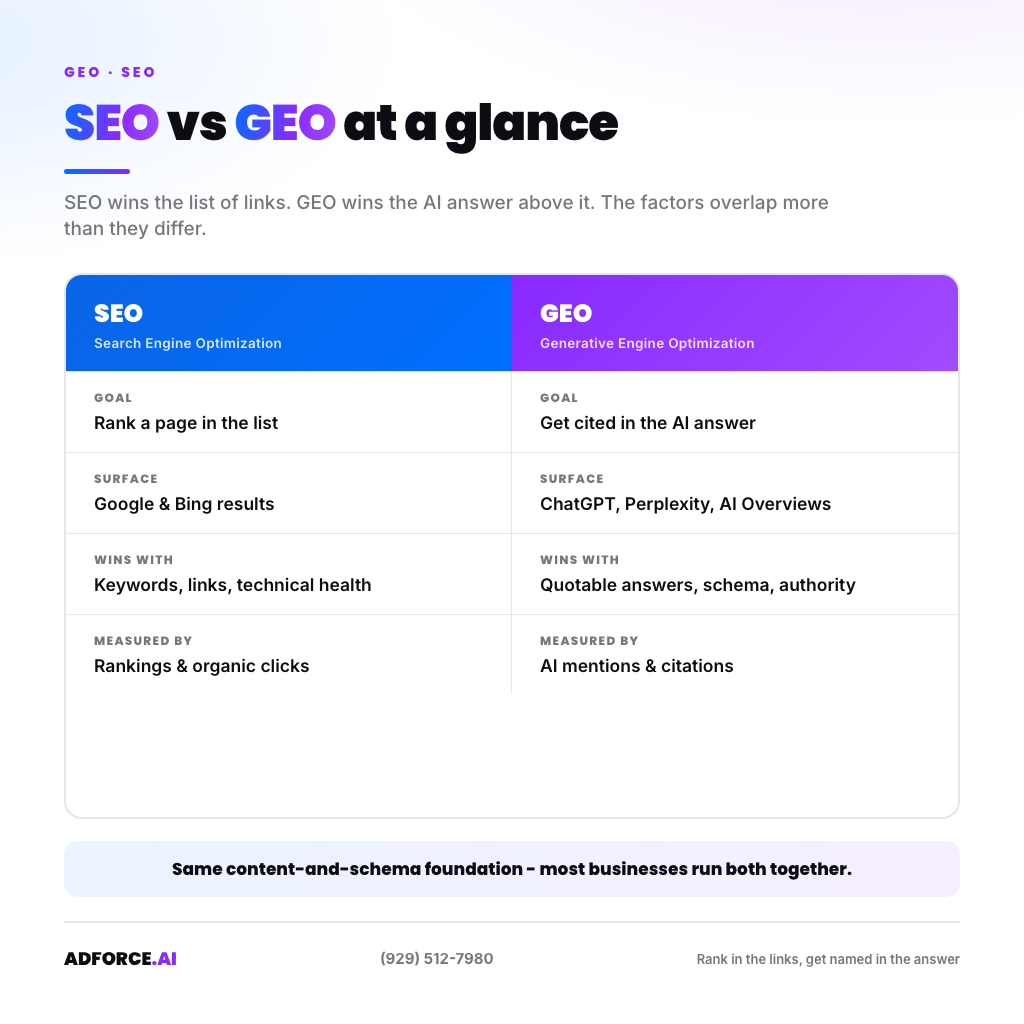
GEO vs SEO at a glance
| SEO | GEO | |
|---|---|---|
| Goal | Rank a page in the list | Get cited in the AI answer |
| Surface | Google/Bing results | ChatGPT, Perplexity, Gemini, Google AI Overviews |
| Wins with | Keywords, links, technical health | Quotable answers, schema, entity authority |
| Measured by | Rankings, organic clicks | AI mentions, citations, referral traffic |
| Time horizon | Established | Emerging - early movers win |
The reframe: they share a foundation
The thing most people get wrong is treating GEO and SEO as separate budgets fighting each other. They are not. The structured content and schema that make AI engines cite you are the same things that help you rank in classic search. The reviews and consistent listings that build entity authority for GEO also strengthen local SEO. Do the foundational work once and both surfaces benefit. That is why we run them as one program, not two.
Which does my business need?
- Local service business (contractor, clinic, law firm): Start with local SEO to win the Map Pack, then layer GEO so you are the name AI recommends.
- Considered B2B or high-ticket purchase: Buyers research with AI before they ever call. GEO is high-leverage here.
- Brand-new site with no authority: Build the SEO foundation (content plus schema) - that same foundation feeds GEO.
The honest answer: they are not either/or. We usually run them together, because the work overlaps and the combined result - ranking in the links AND getting named in the answer - is far stronger than either alone.
How to get started
- Audit what AI engines currently say about you and your competitors.
- Publish answer-ready content for the questions buyers actually ask.
- Add FAQ, organization, and product schema so machines can parse your facts.
- Build consistent entity signals (citations, reviews, mentions).
- Track your visibility across the major engines and iterate.
If that sounds like a lot to run alongside your actual business, it is - which is the case for handing it to a team. Here is our honest take on agency vs freelancer vs in-house, or just book a free call and we will map the fastest path for you.
Frequently asked questions
Is GEO replacing SEO?
No. GEO complements SEO. The foundations overlap, because great content and schema help both. SEO wins the classic results; GEO wins the AI-generated answer that increasingly appears first. The smart play is to run them together.
How do I know if AI is recommending my business?
You benchmark it: ask the major engines (ChatGPT, Perplexity, Gemini, Google AI Overviews) the questions your buyers ask, record whether and how you are mentioned, and track it over time. AdForce does this as part of our GEO service.
Which should a local business do first, SEO or GEO?
Usually local SEO first, to capture the Google Map Pack, then GEO so the AI engines also recommend you. They share a content-and-schema foundation, so doing them together is efficient rather than redundant.
Does GEO require a different website than SEO?
No. GEO builds on the same site. It adds answer-ready content structure and schema rather than a separate website, which is part of why the two disciplines compound instead of competing.
Is GEO worth it for a small business?
Often more so than for big brands, because there is far less competition doing GEO work today and AI engines are actively trying to surface trustworthy local answers. Moving early is a genuine advantage.
How is GEO measured?
By whether and how often AI engines mention and cite you for the questions your buyers ask, plus the referral traffic those citations send. It is tracked as a loop over time, not a single ranking number.