Instagram Ads vs Facebook Ads: Same Engine, Different Rooms (2026)
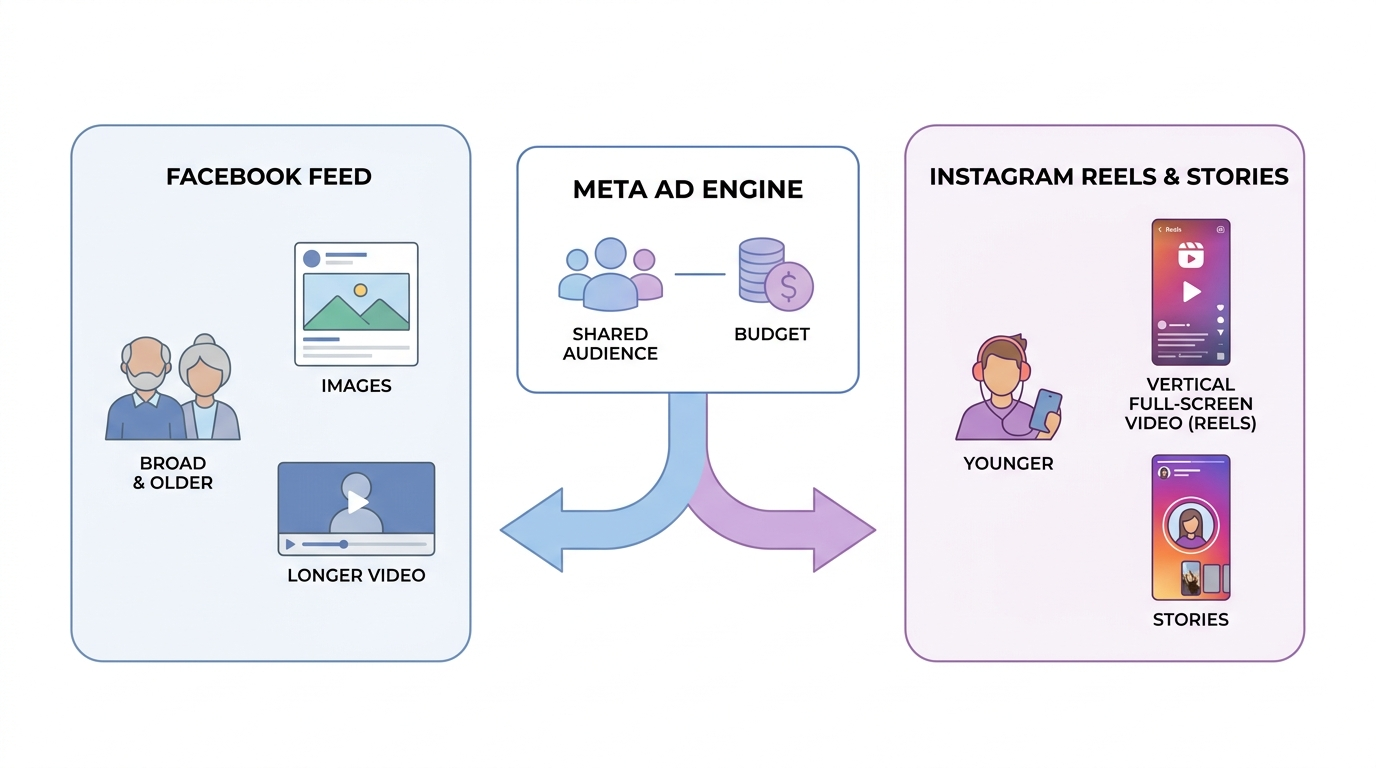
Quick answer: Instagram and Facebook ads are not competing platforms, they are two placements inside one Meta advertising engine, bought from the same Ads Manager with the same targeting data. So the real choice is not which platform, but which placements and creative formats fit your audience and goal. Instagram skews younger and rewards full-screen vertical video in Reels and Stories, while Facebook reaches a broader, older audience and suits Feed images, longer video, and link offers. In 2026 the smart default is to run both and let Advantage+ optimize where each dollar performs best.
Published 2026-07-07 · Paid Ads · by AdForce

You are staring at the Meta Ads Manager, and the placement toggles are all checked by default. Facebook Feed. Instagram Feed. Stories. Reels. Explore. And somewhere in the back of your mind is the question that brought you here: should I run Instagram ads or Facebook ads? Here is the thing almost nobody tells you before you spend a dollar. That question has a hidden false premise baked into it.
Instagram and Facebook are not two competing ad platforms. They are one ad platform wearing two outfits. Both are owned and run by Meta, both are bought through the exact same Ads Manager, both draw from the same targeting data, and both are optimized by the same algorithm. When you "run an Instagram ad," you are running a Meta ad that Meta chose to show in an Instagram placement. The real decision was never the platform. It was the room.
Same engine, different rooms
Picture Meta as one large building with a single front desk that knows everything about who walks in. Facebook and Instagram are two rooms in that building. The people in them overlap heavily, but the mood, the pace, and the way they look around are different. Your ad is the same guest. The only question is which room it should walk into, and when.
This reframe changes the entire conversation. You are not picking a winner between two rivals. You are deciding which placements and creative formats fit your audience and your goal, and then, in most cases, letting Meta spread your budget across both to find the cheapest result. That is a very different job than "Instagram vs Facebook," and it is a much more honest one.
Once you hold that in your head, the classic differences stop being a scary either-or and become a simple map of where each room shines.
Who is actually in each room
The audiences overlap, but they skew. Facebook still has the broadest reach of any social platform on earth, and its core users skew a little older, roughly the 25 to 65-plus range, with a heavy 35-plus concentration. People are there to keep up with family, read news, join local groups, and browse Marketplace. Instagram skews younger and more visual, with a large share of users under 35, and the mindset is discovery: new products, aesthetics, creators, trends.
That difference is not just trivia. It quietly decides which room your customer is standing in. If you sell premium home remodels, memorial services, or B2B software to operations managers, a large slice of your buyers live on Facebook. If you sell skincare, apparel, fitness, food, travel, or anything a 28-year-old shows their friends, Instagram is where attention pools. Most local service businesses land somewhere in between, which is exactly why forcing a single-room choice is usually a mistake.
The part that really differs: the creative
Here is where Instagram and Facebook genuinely diverge, and it has almost nothing to do with targeting. It is the format and the state of mind that format creates.
Instagram is a full-screen, sound-on, vertical world. Reels and Stories take over the entire phone, and they reward motion, faces, quick hooks, and a native feel. An ad that looks like a polished TV spot often gets scrolled past. An ad that looks like a creator filmed it on their phone tends to hold. Facebook Feed, by contrast, is a scrolling, mixed-media environment where a strong image with clear text, a longer video, or a link-heavy offer can all work, and where people are more willing to read a caption or click through to a page.
So the useful question is not "which platform," it is "do I have creative that fits the room I want to enter?" A single square photo will technically run everywhere, but it will underperform in Reels and Stories where full-screen vertical video is the language. This is the most common reason a business decides "Instagram ads do not work for me," when the truth is they fed the Instagram room a Facebook-shaped ad. If producing vertical video feels like a wall, that is a solvable problem, and it is exactly what our video creation service exists to remove.
A note on cost, without the false precision
You will read that Instagram clicks cost a little more than Facebook clicks, or the reverse, depending on the article. Ignore the specific numbers. They swing wildly by industry, season, audience, and creative quality, and any dollar figure printed today is stale by next quarter.
What is durably true: you are not really choosing a price when you choose a placement, because Meta prices each impression by auction in real time. When you let the system run across both Facebook and Instagram, it pushes your budget toward whichever placement is winning cheaper results at that moment. Lock yourself to one room and you take that flexibility away, which usually raises your cost, not lowers it. The reframe most owners miss: cheaper placement is not cheaper customers. Judge everything by cost per lead and cost per booked job, never by cost per click on a single app. If you want to know whether the resulting return is any good, what is a good ROAS shows you how to set the bar from your own margin rather than from an industry average.
When Instagram wins, when Facebook wins
Even inside "run both," there are clear cases where you deliberately weight one room heavier.
| Lean Instagram | Lean Facebook | |
|---|---|---|
| Audience age | Under 35, trend-aware | 35-plus, broad reach |
| Product feel | Visual, aspirational, lifestyle | Practical, considered, local |
| Best format | Reels and Stories, vertical video | Feed image, longer video, link ads |
| Buyer mindset | Discovery and inspiration | Research, groups, Marketplace |
| Great for | Brand, fashion, beauty, food, fitness | Home services, B2B, local, events |
| Weak spot | Small text, link-heavy offers | Younger, video-first audiences |
Read that table as a dial, not a switch. A roofing company might run 70 percent Facebook and 30 percent Instagram. A skincare brand might flip it. Both are still running one Meta campaign. For home and local service businesses specifically, we go deeper in our guide on Facebook ads for home services, and the same logic maps cleanly onto Instagram placements.
The 2026 answer: usually you let Advantage+ decide
Here is what modern Meta advertising actually looks like, and it is the opposite of agonizing over a single toggle. Meta's Advantage+ placements and Advantage+ campaigns are built to take your creative, your goal, and your budget, and then automatically distribute delivery across Facebook, Instagram, and everything in between, learning in real time where each dollar performs best.
In practice, this means the smart default is to turn every placement on, feed the machine multiple creative formats, and let it optimize. Give it a vertical video for Reels and Stories, a clean image for Feed, and maybe a carousel, and Meta will figure out that your under-35 buyers convert from Instagram Reels while your 45-year-olds convert from Facebook Feed, often better than you could have guessed manually. Manually restricting to one platform made sense years ago. Today it mostly just handcuffs the algorithm.
The exception, and it is a real one: if you genuinely know your customer lives in one room, or you are producing creative that only fits one format, then narrowing placements is a deliberate strategic choice, not a shrug. That judgment call, knowing when to trust the machine and when to override it, is most of what a good ad manager actually does. It is the same discipline we bring to every account inside our Facebook and Instagram Ads service.
How this connects to the rest of your funnel
One more reframe, because it decides whether any of this pays off. Instagram and Facebook are both discovery engines. People are scrolling, not shopping. You are creating demand, not catching it. That makes them fantastic at the top of your funnel and mediocre at closing someone who has never heard of you in a single tap.
The businesses that win with Meta ads pair them with something that catches the demand once it turns into intent, usually search. If you are weighing that side of the equation too, our breakdown of Google Ads vs Facebook Ads walks through exactly how the two halves fit together. The short version: Meta fills the top of the funnel across both its rooms, search closes the bottom, and retargeting sweeps up everyone who looked but did not act.
The bottom line
Stop asking "Instagram ads or Facebook ads." Start asking "which rooms, which creative, which goal." The platform question answers itself the moment you frame it that way, because it is the same Meta engine either way, and the engine is very good at spreading your budget for you.
Get your audience and your goal clear, produce creative that actually fits vertical Reels and Stories as well as the Feed, turn on the placements, and let the algorithm do the sorting it was built to do. That is the whole game in 2026. If you would rather have someone own the creative, the targeting, and the daily optimization while you run your business, book a free 15-minute call and we will tell you honestly where your Meta budget should go first.
Frequently asked questions
Are Instagram ads and Facebook ads the same thing?
They run on the same system. Both are owned by Meta and bought through the same Ads Manager, using the same targeting data and the same optimization algorithm. When you run an Instagram ad, you are running a Meta ad placed in an Instagram spot. The difference is the placement and the creative format, not the underlying platform, which is why treating them as two rival platforms usually leads to worse results than running them together.
Which is better for advertising, Instagram or Facebook?
Neither is universally better, it depends on your audience and goal. Instagram skews younger and rewards full-screen vertical video, so it suits visual, lifestyle, and discovery-driven brands. Facebook has broader reach and an older core audience, so it suits local services, B2B, and considered purchases. For most businesses the strongest answer is to run both and weight the budget toward whichever room your customers actually live in.
Are Instagram ads more expensive than Facebook ads?
Sometimes, but the numbers swing constantly by industry, season, and creative quality, so any fixed figure is unreliable. More importantly, Meta prices each impression by real-time auction, so when you run across both placements the system shifts your budget toward whichever is winning cheaper results. Locking to one platform usually raises your cost. Judge by cost per lead and cost per booked job, not cost per click.
Should I run ads on both Instagram and Facebook?
In most cases, yes. Because it is one Meta engine, running both placements lets the algorithm find the cheapest results across the entire audience rather than restricting it to one app. The main exceptions are when you clearly know your customer lives in one room, or when your creative only fits one format, such as vertical video for Reels. Otherwise, turning on all placements is the smart default.
What is Advantage+ and should I use it?
Advantage+ is Meta's set of automated placement and campaign tools that distribute your budget across Facebook, Instagram, and other placements automatically, learning in real time where each dollar performs best. For most advertisers it beats manually restricting placements, as long as you feed it multiple creative formats. The skill is knowing when to trust it and when to override it, which is where an experienced ad manager earns their fee.
Do I need different creative for Instagram and Facebook?
Ideally, yes. Instagram Reels and Stories are full-screen, sound-on, and vertical, and reward native-feeling video with fast hooks. Facebook Feed handles images, longer video, and link-heavy offers well. A single square photo runs everywhere but underperforms in vertical placements. Giving Meta several formats, at minimum a vertical video and a clean Feed image, lets it optimize each placement instead of forcing one shape into every room.
Why do people say Instagram ads do not work for them?
Usually because they fed the Instagram room a Facebook-shaped ad. A static square image or a text-heavy link offer struggles in Reels and Stories, where full-screen vertical video is the language. The fix is rarely to abandon Instagram, it is to produce creative that fits the format. When the creative matches the room, the same audience and targeting often perform very differently.
Are Facebook and Instagram ads enough on their own?
They are excellent at the top of the funnel but they are discovery engines, meaning people are scrolling, not actively shopping. They create demand rather than catch it. To turn that demand into sales you usually pair Meta ads with search, which captures people once they are actively looking, plus retargeting to close everyone who looked but did not act. Run as one connected system, they compound.