Pull vs Push Marketing: Which One Grows Your Business Faster? (2026)
Quick answer: Push marketing means you go to the customer through paid ads, cold outreach, and direct mail, so it delivers leads fast but stops the moment you stop paying. Pull marketing means the customer comes to you through SEO, AI search, content, reviews, and word of mouth, so it starts slowly but compounds and lowers your cost per lead over time. You do not pick one. Push buys speed now, pull lowers cost later, so the smart play is both, in sequence.
Published 2026-07-07 · Guides · by AdForce

You want more customers, and two very different sounding pieces of advice keep landing in your inbox. One says run ads and go get them. The other says write content, rank on Google, get found, and let them come to you. They sound like opposites, and most owners quietly pick a side based on budget or gut feel. That choice is usually the wrong frame. The real question is not push or pull. It is how much of each, and in what order.
Here is the distinction in one line. Push marketing means you go to the customer. Pull marketing means the customer comes to you. Everything else, the channels, the costs, the timelines, follows from that split.
What push marketing actually is
Push is any channel where you initiate the contact. The person was not looking for you, and you interrupt their day with an offer. That covers Google and Meta ads, cold email and cold calls, direct mail, paid influencer placements, and most outbound sales. You are pushing your message out into the world and paying, in money or effort, for attention.
The defining trait of push is that it works on demand. Turn it on today, and leads can show up this week. Turn it off, and they stop. You rent the audience. You never own it.
That speed is the whole appeal. A new business with no reputation and no search rankings has exactly one way to get customers this month, and it is push. Same for a seasonal promotion, a new location opening, or a product nobody is searching for yet because they do not know it exists. Push creates demand where none existed and captures demand faster than any organic channel can.
What pull marketing actually is
Pull is any channel where the customer initiates. They have a problem, they go looking for a solution, and your business is what they find. That covers SEO and the Google Map Pack, the new world of AI search where ChatGPT or Google's AI recommends you by name, helpful blog content and videos, your reputation and reviews, and plain old word of mouth.
The defining trait of pull is that it compounds. A blog post you publish today can bring leads for years. A five-star reputation makes every other channel cheaper. Rankings you earn this quarter do not disappear when you stop paying, because you were never paying for placement, you were earning it. You are not renting the audience. Over time, you own the asset that produces them.
The catch is patience. Pull is slow to start. SEO can take months to move. Content needs volume before it compounds. Word of mouth needs happy customers first, which needs customers first. Pull rewards the business that started two years ago, which is exactly why so many owners never start it and stay stuck renting attention forever.
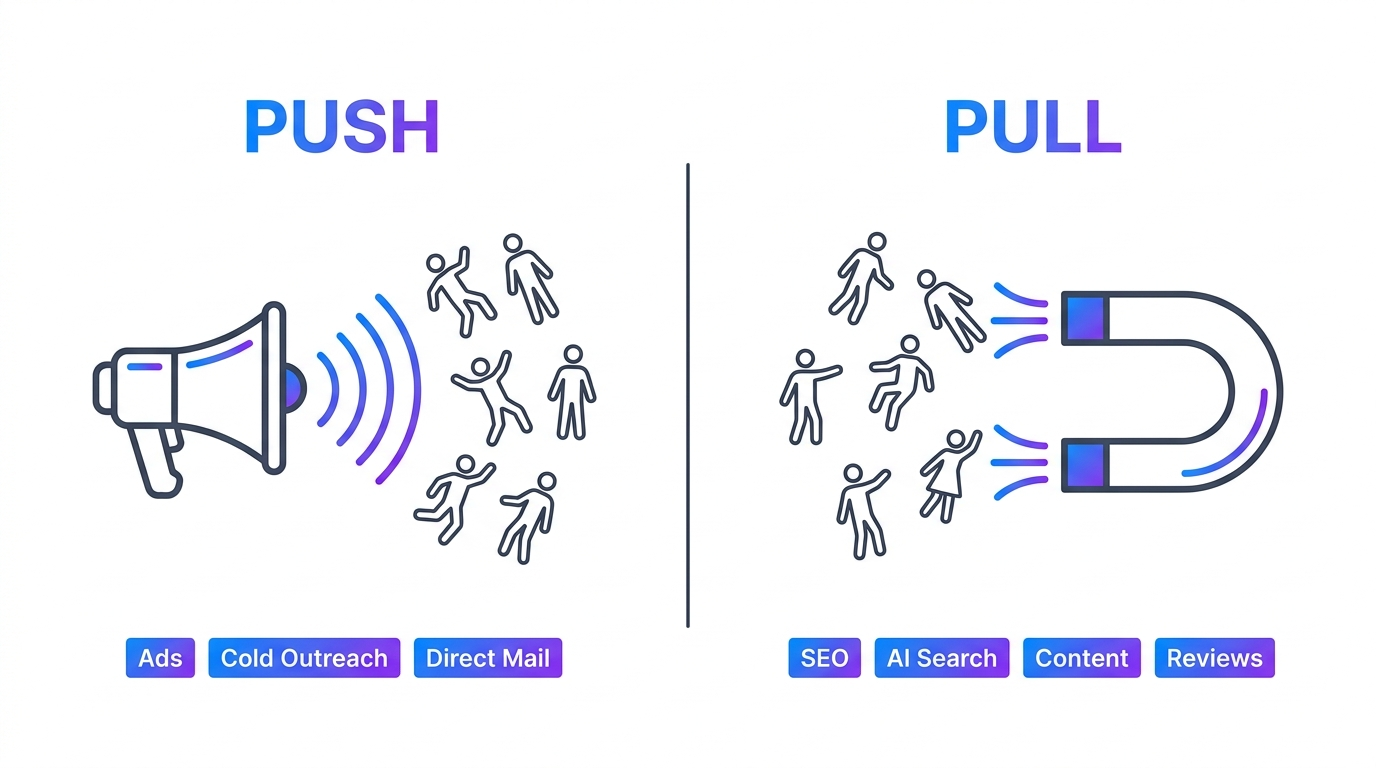
The honest pros and cons, side by side
Neither one is better. They are good at different jobs, and the trade-offs are real. Here is the shape of the decision without the marketing gloss.
| Push marketing | Pull marketing | |
|---|---|---|
| Who starts | You reach out to them | They come looking for you |
| Channels | Paid ads, cold outreach, direct mail | SEO, GEO, content, reviews, word of mouth |
| Buyer intent | Often low, you interrupt | High, they are already shopping |
| Speed to first leads | Fast, days to weeks | Slow, months to compound |
| Cost over time | Stays flat or rises, you keep paying | Drops per lead as the asset grows |
| What happens when you stop | Leads stop immediately | Leads keep coming for a while |
| You own or rent | Rent the audience | Own the asset |
| Biggest risk | Overspend, ad fatigue, thin margins | Impatience, quitting before it compounds |
Read that table and the temptation is to declare pull the winner. Cheaper over time, higher intent, you own it. But that ignores the one thing pull cannot do, which is put a lead on your calendar this Friday. A business that only does pull starves while it waits to compound. A business that only does push is on a treadmill it can never step off, because the day the ad budget stops, so does the phone.
The reframe that changes how you spend
Most owners treat this as an either or decision and pick the one that matches their temperament. The patient, brand-minded owner leans pull and wonders why growth is so slow. The impatient, numbers-driven owner leans push and wonders why customers cost so much and never seem to get cheaper.
The truth is that push buys you speed now, and pull lowers your cost later, so you need both and you sequence them. They are not rivals. They are two halves of one system that feed each other.
Watch how they connect. You run ads to a market that has never heard of you. Some people buy right away. Many more see you, do not click, but now recognize your name. Weeks later, when they actually need what you sell, they do not search for a generic term, they search for you, or they ask ChatGPT for a recommendation and your name is one it knows. That later search is pull, and push is what seeded it. Meanwhile every happy customer that ads brought you leaves a review and tells a neighbor, which strengthens your pull for free.
It runs the other way too. Strong pull makes your push cheaper. When your reputation is solid and your name is familiar, your ads convert at a higher rate, so the same budget buys more customers. Cold traffic that already trusts you is not really cold.
When to lean push, when to lean pull
You do not split the budget fifty fifty and call it a day. The right mix depends on where you are.
Lean push when you are new and nobody knows your name, when you are launching something people are not searching for yet, when you have a time-sensitive promotion, or when you need cash flow now and cannot wait for organic to compound. If you need calls this month, that is a paid ads problem first. Our Google Ads and Facebook and Instagram Ads work exists mostly to make that fast lane profitable instead of a money pit, and we go deeper on choosing between them in Google Ads vs Facebook Ads.
Lean pull when you sell something people actively search for, when your margins are thin and paid clicks eat the profit, when you are playing a long game in one market, or when you already have push running and want to bring your cost per customer down over time. This is the work behind local SEO and the newer, fast-growing surface of AI search optimization, where getting recommended by an AI engine is becoming its own channel. If you are weighing those two, GEO vs SEO breaks down how they differ.
For almost every established business, the answer is a barbell. Keep push running so leads never stop, and invest steadily in pull so that a year from now, a growing share of your customers arrive without a click charge attached. The push holds the floor. The pull raises the ceiling and lowers the cost of everything underneath it.
The mistake that wastes both
The most common failure is not picking the wrong side. It is running push and pull as two disconnected projects that never talk to each other. Ads point to a page that content never supports. Content ranks but has no offer or follow-up behind it. Leads come in from both and nobody calls them back fast enough, so the intent you paid for or earned goes cold on the vine.
Push and pull only pay off when they share the same funnel, the same tracking, and the same fast follow-up. The ad and the blog post should tell the same story. The reputation you build should make the ad convert better. And every lead, no matter which channel produced it, should hit a system that responds in seconds, not hours. That connective tissue is where most of the money is quietly won or lost.
How AdForce thinks about the mix
We do not sell you a side. We start from where your business actually is. If you need leads now, we build the push engine first and make it profitable, then layer pull underneath so your cost per customer drops as the months go by. If you already have demand and want to stop renting all of it, we build the pull assets, SEO, GEO, content, and reputation, that keep producing after the invoice is paid. Real strategists own the plan, and the best AI handles the optimization in between.
If you want an honest read on where your first or next dollar should go, push or pull, book a free 15-minute call and we will look at your numbers with you. What is holding your growth back today, speed or cost?
Frequently asked questions
What is the difference between push and pull marketing?
Push marketing means you go to the customer and interrupt them with your message, through channels like paid ads, cold outreach, and direct mail. Pull marketing means the customer comes to you because they went looking for a solution and found you, through SEO, AI search, content, reviews, and word of mouth. Push creates and captures demand fast but you keep paying for it. Pull is slower to start but compounds and gets cheaper per lead over time.
Is pull marketing better than push marketing?
Neither is better on its own, because they do different jobs. Pull produces cheaper, higher-intent customers over time and you own the asset, but it cannot fill your calendar this week. Push delivers leads fast but the flow stops the moment you stop paying. Most successful businesses run both: push to hold the floor and get customers now, pull to lower the cost of everything over time.
Which should a new business start with, push or pull?
A brand-new business with no rankings, reviews, or reputation usually has to start with push, because it is the only channel that can produce customers in the first few weeks. Ads and outreach create awareness and cash flow while you begin building the slower pull assets like SEO, content, and a review base underneath. As pull compounds, you can rely less on paid channels and your cost per customer drops.
Are SEO and content marketing push or pull?
They are pull. With SEO, GEO, and content, the customer initiates the contact by searching or asking an AI engine for a solution, and your business is what they find. You are earning attention by being genuinely useful rather than paying to interrupt. That is why pull channels compound: a piece of content or a ranking you earn can keep bringing leads long after it was published.
Do paid ads count as push marketing?
Yes. Google Ads, Facebook and Instagram Ads, and other paid placements are push, because you are initiating the contact and paying to put your message in front of people rather than waiting for them to come to you. The one nuance is Google Search ads, which reach people who are already searching, so they carry higher intent than most push. But you are still renting the placement, which is the defining trait of push.
Can push marketing help my pull marketing?
Very much so, and this is the part most owners miss. Ads put your name in front of people before they need you, so weeks later they search for you by name or an AI recommends you, which is pull that push seeded. Every customer ads bring you also leaves reviews and tells others, strengthening your organic presence. Push and pull feed each other when you run them as one connected system.
How should I split my budget between push and pull?
There is no fixed ratio, it depends on your stage. If you need leads now or are launching something new, weight toward push. If you sell what people already search for and want to lower your long-term cost, weight toward pull. For most established businesses the smart setup is a barbell: keep push running so leads never stop, while investing steadily in pull so a growing share of customers arrive without a click charge attached.
What is the biggest mistake businesses make with push and pull?
Running them as two disconnected projects that never talk to each other. Ads point to pages that content does not support, content ranks but has no offer behind it, and leads from both channels go cold because nobody follows up fast enough. Push and pull only pay off when they share the same funnel, the same tracking, and the same fast follow-up.