Marketing for Real Estate Investors: How to Build a Predictable Motivated-Seller Pipeline in 2026
Quick answer: Marketing for real estate investors is the system that turns strangers into motivated-seller appointments: a sharp offer, two or three lead channels (paid search, SEO, and direct outreach), instant speed-to-lead follow-up, and a CRM that never drops a thread. The investors who win in 2026 are not the ones with the biggest budget - they are the ones who reply in minutes, follow up for months, and measure cost per signed contract instead of cost per click. This is built for investors, wholesalers, flippers, and funds, not for listing agents.
Published 2026-06-19 · Real Estate · by AdForce

You have bought leads before. You paid for a batch, called them once, got three voicemails and a "we already sold," and quietly decided marketing does not work for investors. The problem was never the leads. It was that you treated a pipeline like a vending machine - insert money, expect a deal to fall out.
Motivated-seller marketing is not a transaction. It is a system that compounds: the same dollar that gets you nothing in week one gets you a contract in week ten, because by then your follow-up, your speed, and your reputation are doing the heavy lifting. Here is how serious investors build that system in 2026.
What "investor marketing" actually means (and who it is for)
First, the boundary. This guide is for people who buy property - investors, wholesalers, fix-and-flippers, and funds. It is not agent marketing. Agents market a listing to buyers; investors market themselves to sellers who need to move a property fast and are willing to trade some price for speed and certainty.
That difference changes everything downstream. Your offer is not "I will get you top dollar." It is "I will buy your house as-is, on your timeline, with no showings and no repairs." Every channel below exists to put that offer in front of someone at the moment they start thinking "I just need this done."
The reframe: you are not buying leads, you are building a pipeline
The single biggest mistake is optimizing for cost per lead. A $12 lead that you never close is infinitely expensive. A $300 lead that becomes a $20,000 assignment fee is nearly free. What you actually want to lower is cost per signed contract, and that number is driven far more by follow-up than by ad spend.
Industry-wide, most motivated-seller deals close after five or more touches, yet most investors stop after one or two. The money is in the gap between touch two and touch eight - exactly where automation earns its keep. That gap is what our AI real-estate automation service is built to close, and we go deep on the machinery in our guide to AI marketing automation.
The channels that actually produce motivated sellers
There is no single best channel. There is the right mix for your market, budget, and how fast you need deals. Here is the honest breakdown.
| Channel | Speed to first deal | Cost profile | Lead intent | Best for |
|---|---|---|---|---|
| Google / PPC ("sell my house fast") | Fast (days) | Higher cost per lead, high intent | Very high | Investors who need deals now and can answer the phone |
| SEO / content (we-buy-houses site) | Slow (months) | Low cost per lead once ranked | High | Building a durable, cheap lead source over time |
| Direct mail | Medium (weeks) | Predictable, scales with budget | Medium | Targeted lists (absentee, pre-foreclosure, tired landlords) |
| Cold call / SMS / RVM | Fast | Cheap per contact, labor-heavy | Variable | High-volume wholesalers with a dialer and a team |
| Referrals / past sellers | Ongoing | Nearly free | Very high | Every investor - criminally underused |
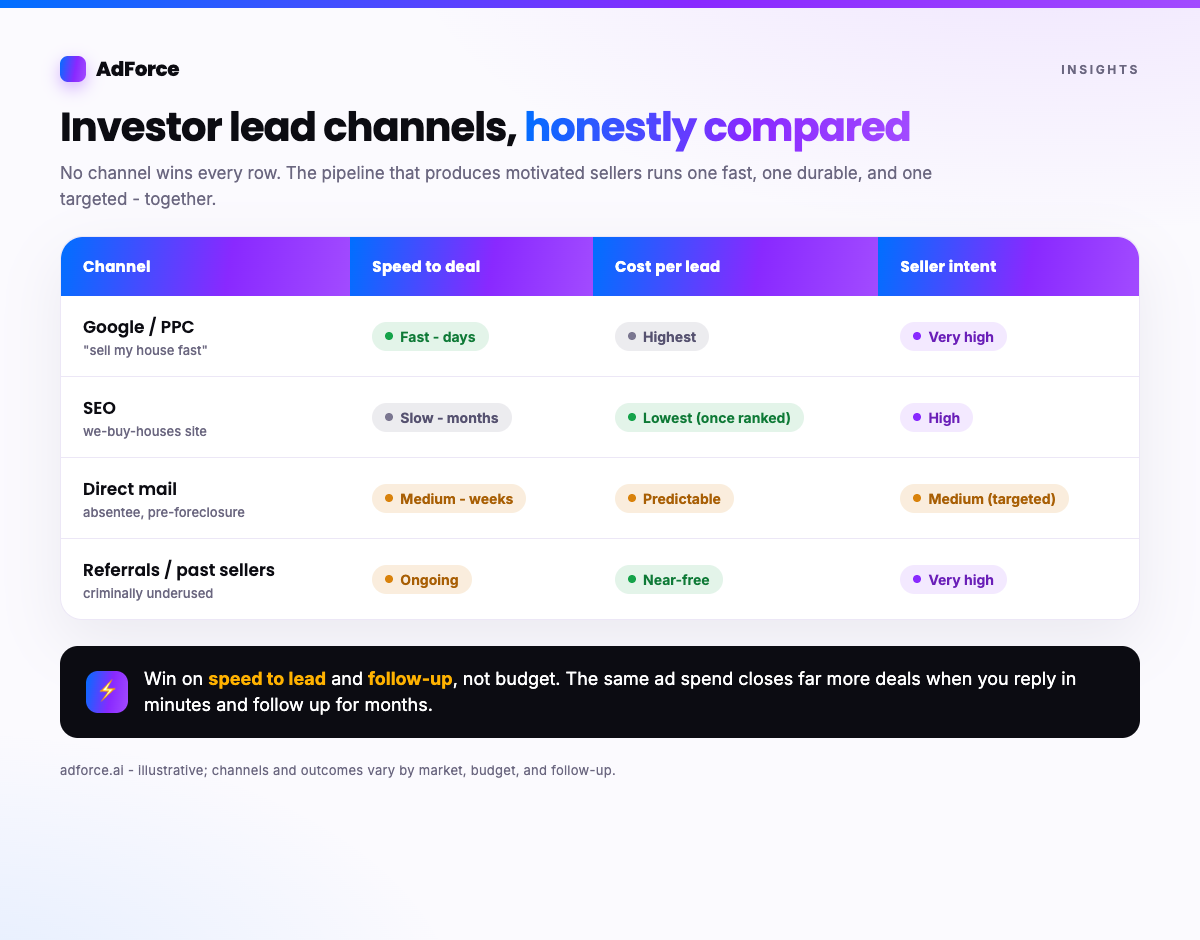
The pattern that works for most investors: one fast channel to create deals this month (usually Google Ads), one durable channel to lower your blended cost over time (an SEO-driven we-buy-houses site plus local SEO), and one targeted channel (direct mail or outreach) aimed at the lists most likely to be motivated.
Speed to lead: the unfair advantage almost nobody uses
Here is the closest thing to a cheat code in investor marketing. A motivated seller who fills out your form is, at that exact moment, also filling out two competitors' forms. The investor who calls back first wins a wildly disproportionate share of those deals.
The data is brutal: respond within 5 minutes and you are many times more likely to connect and qualify than if you wait even 30. Yet most investors are on a job site, at a closing, or asleep when the lead comes in. That is the entire case for automation - an instant text-back and a booked callback the moment a lead hits, so no opportunity ages out while you are busy being an investor. (This is exactly what our AI real-estate automation service runs for clients.)
The follow-up engine (where deals actually come from)
Once a lead is captured and contacted, the long game begins. A real follow-up system looks like this:
- Instant response - automated text and email within seconds, plus a task to call.
- Multi-touch cadence - a sequence of calls, texts, and emails over weeks, not a single attempt.
- Long-term nurture - the "not yet" sellers (most of them) drip into a monthly touch for 6 to 12 months. Circumstances change; the investor still in their inbox when it does gets the call.
- Clean CRM hygiene - every lead tagged by source, status, and motivation so you know what to spend more on.
This is unglamorous and it is where the margin lives. If you want to see the underlying tech, our automation guide breaks down the exact stack, and our take on custom software covers when it is worth building your own tool instead of duct-taping five.
Tools and AI: analyze faster, follow up automatically
Two places technology changes the investor game in 2026:
- Deal analysis. Speed to a confident number matters as much as speed to the seller. This is exactly why we built NextProp AI - an AI deal analyzer that gives you a cash-flow and returns verdict in about 60 seconds, then helps draft the LOI. The faster you can say "yes, at this number," the more sellers say yes back.
- Lead handling. AI agents now qualify inbound sellers 24/7, answer the obvious questions, and book the callback - so a lead at 11pm is warm by morning instead of cold.
The investors pulling ahead are not replacing judgment with AI. They are using AI to do the repetitive work - instant response, qualification, analysis - so their human time goes to the conversations and offers that actually close.
Real math: what a predictable pipeline costs
Say you want one to two wholesale or flip deals a month. A realistic starting model:
| Line item | Rough monthly |
|---|---|
| Ad spend (PPC + a targeted channel) | $2,000 - $5,000 |
| Website + SEO foundation | A few hundred, amortized |
| CRM + automation + AI follow-up | Low hundreds |
| Your time (or a VA) on live calls | Variable |
| Result at a healthy funnel | 1-2 contracts, each worth many multiples of the spend |
The numbers vary by market and by how disciplined your follow-up is. But the shape holds: a tight system at a modest budget beats a sloppy system at a big one, every time. If you would rather not assemble this yourself, that is precisely the kind of pipeline we build - see how we work across industries or book a free call.
The bottom line
- Optimize for cost per contract, not cost per lead.
- Run two or three channels: one fast, one durable, one targeted.
- Win on speed to lead and follow-up - that is where deals hide.
- Let AI handle instant response, qualification, and analysis so your time goes to closing.
Investor marketing is not magic and it is not luck. It is a pipeline you can measure and improve. For how we build the whole acquisition presence around it, see marketing for real estate investors and cash home buyers. If you want help building one that actually produces motivated sellers, book a free 15-minute call and we will map it for your market.
Frequently asked questions
Is this marketing for real estate agents or investors?
Investors. This is about generating motivated-seller leads for people who buy property - investors, wholesalers, flippers, and funds. Agent marketing (promoting listings to buyers) is a different game with a different message and different channels.
What is the best lead channel for real estate investors?
There is no single best one. Most successful investors run a mix: a fast channel like Google Ads for deals this month, a durable channel like an SEO-driven we-buy-houses site to lower cost over time, and a targeted channel like direct mail or cold outreach to motivated lists. The mix depends on your budget and timeline.
How fast should I respond to a motivated-seller lead?
Within five minutes if you possibly can. A seller filling out your form is usually contacting competitors at the same moment, and responding first dramatically increases your odds of connecting and signing. This is why automated instant text-back and booked callbacks matter so much.
How many times should I follow up with a seller?
Far more than most investors do. Many deals close after five or more touches, and the long-term "not yet" sellers can convert months later. A real cadence runs calls, texts, and emails for weeks, then drips into a monthly nurture for six to twelve months.
How much should a real estate investor spend on marketing?
A realistic starting point for one to two deals a month is roughly $2,000 to $5,000 in ad spend plus a modest stack for website, CRM, and automation. What matters more than the number is follow-up discipline - a tight system at a small budget beats a sloppy one at a large budget.
Can AI really help with real estate investing?
Yes, in two practical ways: analyzing deals fast (tools like NextProp AI return a cash-flow and returns verdict in about a minute) and handling leads (AI agents qualify sellers 24/7 and book callbacks). AI does the repetitive work so your time goes to offers and conversations that close.