How AI Is Changing Marketing in 2026 (and What to Actually Do About It)
Quick answer: In 2026, AI is changing marketing in four concrete ways: buyers now start research inside AI answer engines (so getting cited matters as much as ranking), content and creative are produced faster but commoditized (so strategy and authenticity win), lead follow-up and qualification are increasingly automated (so speed becomes a baseline expectation), and custom AI tools are now affordable for small businesses. The winners are not the ones who use the most AI - they are the ones who use it to do the repetitive work while humans own strategy, judgment, and relationships.
Published 2026-06-19 · AI & Automation · by AdForce

There are two equally wrong takes on AI and marketing. One says AI changes nothing and it is all hype. The other says AI replaces marketers entirely and you can fire your team. The truth in 2026 is more useful than either: AI has not replaced marketing, it has raised the floor on execution - which means the things machines cannot do (strategy, taste, trust, judgment) are now where the real advantage lives.
Here is what actually changed, and a practical plan for what to do about it without drowning in hype.
1. Buyers now start in AI, not just Google
The biggest shift is in how people find businesses. A growing share of buyers open ChatGPT, Perplexity, Gemini, or Google's AI Overviews and ask "who is the best remodeler in Miami?" or "what is the best tool for analyzing rental properties?" - and they act on the names those tools return.
That created an entire discipline: Generative Engine Optimization (GEO) - getting your business cited inside AI answers. It shares a foundation with classic SEO but is not the same thing. If you only do one piece of homework from this article, understand GEO vs SEO and how to get recommended by ChatGPT. Early movers are winning citations their competitors do not even know exist yet.
2. Content got faster - and more commoditized
AI can draft a blog post, a caption, or ten ad variations in seconds. That is genuinely useful. It also means everyone can produce generic content instantly, so generic content is now worth roughly nothing.
The reframe: when execution is free, the scarce things become valuable. In 2026 that means:
- Strategy and angle - what to say and why it matters, which AI cannot decide for you.
- Authenticity and proof - real photos, real results, real point of view. AI slop is easy to spot and easy to ignore.
- Distribution - getting the content in front of the right people, which is still a human and systems problem.
Use AI to accelerate production, never to replace the thinking. The brands losing right now are the ones publishing obviously machine-written filler and wondering why it does not convert.
3. Follow-up and qualification are automated by default
This is the quiet revolution that matters most for local and service businesses. AI agents now answer inbound leads 24/7, qualify them, answer common questions, and book the appointment - in the seconds after a lead comes in, not the hours later when a human gets free.
Because some businesses now respond instantly, fast response has become the baseline expectation, not a differentiator. If a competitor's AI texts a lead back in 30 seconds and you call tomorrow morning, you lose - regardless of who does better work. We break the full system down in our AI marketing automation guide, and AI business agents are how we deploy it.
4. Custom AI tools are finally affordable
Building bespoke software used to mean a six-figure budget and a year. AI-assisted development has collapsed that cost and timeline, so a small business can now justify a custom tool that does the one thing off-the-shelf software does badly for its niche.
We see this firsthand - we built NextProp AI, an AI deal analyzer for real estate investors, and Glowmark, a Google Business Profile autopilot for local businesses. The point is not those specific tools; it is that "build the exact thing we need" is now on the table for businesses it never was before. When it makes sense to build versus buy is its own decision - we cover it in custom software vs off-the-shelf.
What this means at a glance
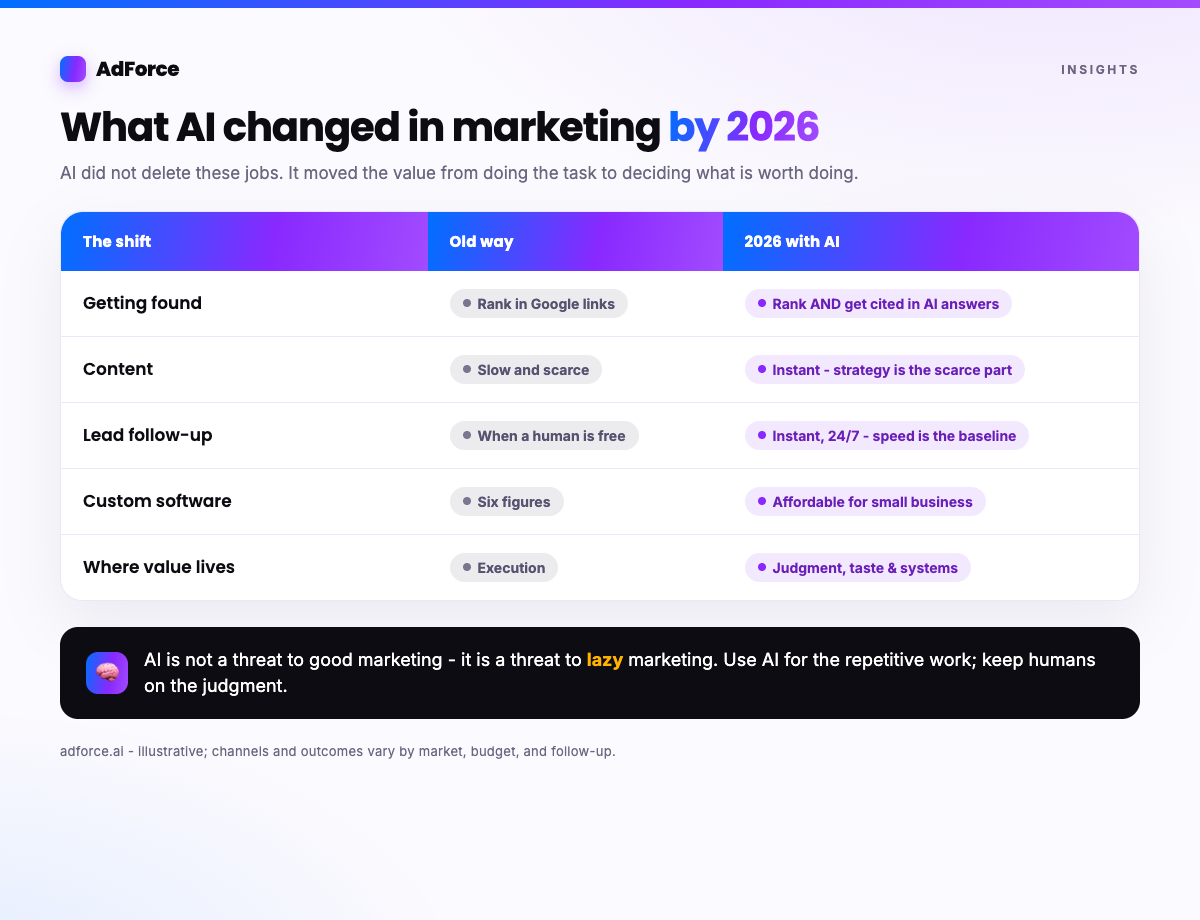
| Old way (pre-AI) | 2026 with AI |
|---|---|
| Rank in Google's links | Rank AND get cited in AI answers (GEO) |
| Content is slow and scarce | Content is instant - strategy and authenticity are scarce |
| Follow up when a human is free | Instant, automated, 24/7 - speed is the baseline |
| Custom software = six figures | Custom tools affordable for small business |
| Marketing = execution | Marketing = judgment, taste, and systems |
The hype-free action plan
You do not need to adopt every tool. You need to do these five things:
- Get visible in AI search. Audit what ChatGPT and Google AI say about you and your competitors, then publish answer-ready content and schema. Start with GEO.
- Automate instant follow-up. If nothing else, never let a lead wait. This alone pays for most AI investments.
- Use AI to draft, humans to decide. Speed up production, but keep a real strategist and a real point of view in the loop.
- Double down on authenticity. Real photos, real results, real voice - the things AI cannot fake are now your moat.
- Consider one custom tool for the workflow your niche software handles badly. It is cheaper than you think now.
The bottom line
AI in 2026 is not a threat to good marketing - it is a threat to lazy marketing. It raised the floor on execution, so the differentiators are now strategy, authenticity, speed, and the systems that tie them together. Use AI for the repetitive work; keep humans on the judgment.
If you want a partner who pairs real strategists with the best AI and automation - and can build the tool when one does not exist - that is exactly what we do. Book a free call or read our honest take on agency vs freelancer vs in-house.
Frequently asked questions
Is AI going to replace marketers?
No. In 2026 AI has raised the floor on execution - drafting content, qualifying leads, analyzing data - but it cannot set strategy, build trust, or exercise judgment and taste. The marketers who thrive use AI to handle repetitive work so their time goes to the decisions and relationships that actually move results.
What is the most important way AI is changing marketing?
Two stand out. First, buyers increasingly start in AI answer engines, so getting cited (GEO) matters alongside ranking. Second, lead follow-up is now automated and instant, which has made fast response a baseline expectation rather than an advantage. Businesses that ignore either fall behind quietly.
Should I use AI to write my marketing content?
Use it to draft and accelerate, not to decide. AI is excellent for first drafts, variations, and speed, but generic AI content is everywhere now and converts poorly. Keep a human strategist setting the angle and adding real proof and voice - that authenticity is what AI cannot replicate.
What is GEO and why does it matter in 2026?
GEO (Generative Engine Optimization) is the practice of getting your business cited inside AI answers from ChatGPT, Perplexity, Gemini, and Google AI Overviews. It matters because a growing share of buyers research with AI first and act on the names it returns. It shares a foundation with SEO but is a distinct, early-mover discipline.
Are custom AI tools realistic for a small business now?
Yes. AI-assisted development has dramatically lowered the cost and timeline of building software, so a custom tool for the one workflow your off-the-shelf software handles badly is now affordable for businesses it never was before. The build-versus-buy decision still matters, but it is a real option in 2026.
How do I start using AI in my marketing without wasting money?
Start with two high-leverage moves: automate instant lead follow-up so no opportunity ages out, and get visible in AI search with answer-ready content and schema. Use AI to draft content but keep humans on strategy, and only consider custom tools once the basics are running.