Marketing for Law Firms in 2026: How to Generate Qualified Cases Without Wasting Spend
Quick answer: Law-firm marketing in 2026 is about qualified cases, not raw leads. The highest-return work is owning local search for your practice area and city, getting cited by AI answer engines, building a steady stream of genuine reviews, and responding to every inquiry within minutes with a clean intake process. For high-value practices, one signed case can pay for months of marketing - so the goal is precision and speed, not volume. The same playbook applies to most advisory and professional-services firms.
Published 2026-06-19 · Professional Services · by AdForce

Law firms waste more marketing money than almost any other category, and it is usually for the same reason: they buy leads when what they need are qualified cases. A personal-injury firm does not want 200 form fills, 190 of which are fender-benders outside their criteria. It wants the handful of cases worth signing - and a system that finds them, filters them, and responds before a competitor does.
This guide is written for law firms, but the playbook applies to most professional-services practices - advisory, accounting, consulting, and the kind of high-value B2B work where one signed client is worth a great deal. (We have built exactly this for clients like a corporate-investigations and litigation-support firm.) Here is how to market a professional practice in 2026 without lighting budget on fire.
The reframe: qualified cases, not leads
Everything changes when you measure the right thing. In high-value professional services, the metric is cost per signed case, not cost per lead or cost per click. That single shift reorders your priorities:
- You would rather have 10 well-qualified inquiries than 100 random ones.
- A higher cost per lead is fine if those leads convert to real matters.
- Filtering and intake quality matter as much as lead volume.
Hold that lens over every tactic below.
1. Own local search for your practice area
When someone needs a lawyer, they search "[practice area] attorney near me" or "[city] [practice area] lawyer," and they overwhelmingly choose from the top local results and the map pack. Winning there is the highest-return work most firms can do.
- Optimize your Google Business Profile for each practice area and location.
- Build dedicated pages for each practice area and each city you serve - specificity wins.
- Earn the reviews and citations that drive map-pack ranking.
Our local SEO guide is the full playbook; for firms it is the foundation everything else sits on.
2. Get cited by AI answer engines
Clients increasingly ask ChatGPT, Gemini, or Google's AI Overviews "what should I do if..." or "who handles [situation] in [city]?" - and the firms those tools name get the call. This is GEO, and law is a category where it matters a lot, because so much legal search is question-shaped.
Publishing clear, authoritative answers to the exact questions clients ask - and structuring them so machines can parse them - earns citations your competitors are not even chasing yet. Start with GEO vs SEO and how to get recommended by ChatGPT.
3. Reviews and reputation: the trust multiplier
People do not hire a lawyer they do not trust, and online reviews are the modern referral. A steady stream of genuine reviews lifts both your map-pack ranking and your conversion rate - the same traffic signs more cases when the reputation is strong.
The key word is steady. A systematic, ethical process for requesting reviews from satisfied clients beats a sporadic scramble, and it compounds over time.
4. Fast intake: where firms quietly lose cases
Here is the painful part. A potential client with an urgent legal problem is anxious and ready to act now. They fill out three firms' contact forms. The firm that responds first, professionally, wins a hugely disproportionate share of those cases - and most firms are in court, with a client, or closed when the inquiry lands.
The fix is the same as in every other industry, applied with professional polish:
- Instant acknowledgment - an immediate, reassuring response so the client knows they reached a real firm.
- Fast human follow-up - a booked consultation while the client is still in decision mode.
- Clean intake and qualification - so your team spends time on the matters worth signing, not chasing dead ends.
AI handles the instant, around-the-clock part without losing professionalism - our automation guide and AI business agents cover exactly this. For a busy practice, this is often the single highest-ROI change available.
Why the math favors precision
| Approach | What it optimizes | Result for a high-value practice |
|---|---|---|
| Buy max leads, cheapest | Cost per lead | Wasted intake time, low close rate |
| Target qualified, respond fast | Cost per signed case | Fewer, better inquiries that convert |
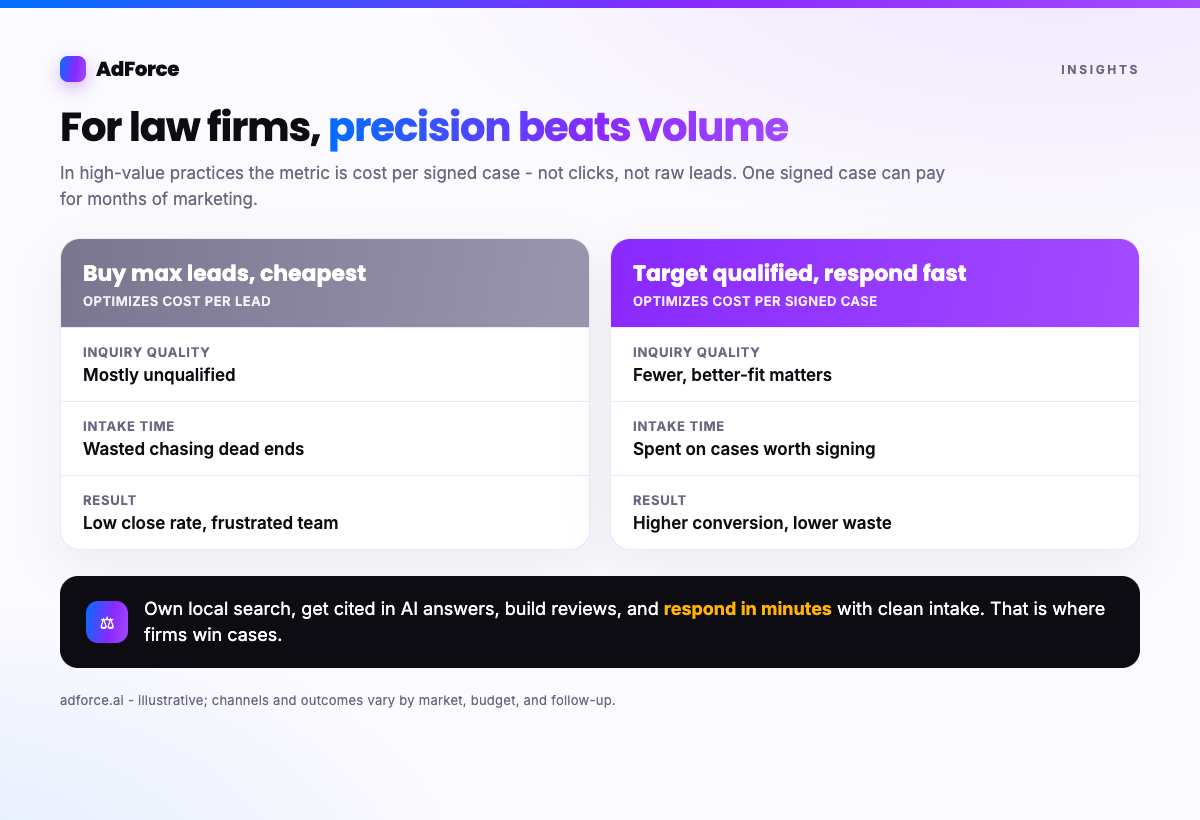
For a practice where a signed case is worth thousands or more, this is not close. Precision plus speed beats cheap volume every time, because your scarce resource is qualified attorney time, not clicks.
The bottom line
- Measure cost per signed case, not cost per lead.
- Own local search for each practice area and city - it is the foundation.
- Get cited in AI answers - legal search is question-shaped and GEO is wide open.
- Build a steady review engine - trust converts.
- Respond in minutes with clean intake - it is where firms win or lose cases.
Whether you run a law firm or another high-value professional practice, the path is the same: precision, trust, and speed. If you want a partner to build that system, book a free call and we will map it for your practice.
Frequently asked questions
What is the best marketing channel for law firms?
Local search is usually the highest-return channel: ranking in the map pack and top results for "[practice area] attorney near me" captures people at the moment of need. It is best paired with AI-search visibility (GEO), a steady review engine, and fast intake, since those convert the traffic local SEO produces.
Why is my law firm getting unqualified leads?
Usually because the strategy optimizes for lead volume and cost per lead rather than qualified cases. Tightening targeting to your specific practice areas and criteria, adding qualifying steps in intake, and focusing spend on high-intent local search all raise lead quality and reduce wasted attorney time.
Does AI search matter for law firms?
Yes, significantly. A lot of legal research is question-shaped ("what should I do if..."), and clients increasingly ask AI engines and act on the firms those tools name. Publishing clear, authoritative, well-structured answers earns citations (GEO) that most firms are not yet competing for - an early-mover advantage.
How fast should a law firm respond to an inquiry?
Within minutes. Potential clients with urgent legal problems typically contact several firms at once, and the first to respond professionally wins a disproportionate share of cases. An instant automated acknowledgment plus fast human follow-up and clean intake is often the highest-ROI improvement a firm can make.
How important are reviews for a law firm?
Very. Reviews are the modern referral - they lift both your map-pack ranking and your conversion rate, since clients do not hire a lawyer they do not trust. A systematic, ethical process for requesting reviews from satisfied clients compounds over time and meaningfully increases signed cases from the same traffic.
Does this marketing approach work for other professional services?
Yes. The same playbook - own local search, get cited in AI answers, build reviews, and respond fast with clean intake - applies to advisory, accounting, consulting, and most high-value B2B practices where one signed client is worth a lot and qualified time is the scarce resource.