Paid Advertising Strategy: A Practical Framework to Build One From Scratch (2026)
Quick answer: A paid advertising strategy is a chain of decisions, not a list of platforms. Start from a specific goal, calculate your customer value and target cost per acquisition, pick one primary platform based on intent versus discovery, split budget across the funnel (awareness, consideration, conversion, retargeting), test creative with discipline, and judge everything on cost per sale. The real skill is deciding what NOT to spend on.
Published 2026-07-07 · Paid Ads · by AdForce

You have money set aside for ads and a dozen tabs open: Google, Meta, TikTok, YouTube, a LinkedIn rep in your inbox. The temptation is to sprinkle a little everywhere and see what sticks. That is not a strategy. That is how a $2,000 budget becomes $2,000 of noise, spread so thin that no single channel ever gets enough data to work.
A real paid advertising strategy is not a list of platforms you are on. It is a short chain of decisions that starts with one goal and ends with a number you can defend. Get the chain right and the platform question mostly answers itself. Here is the reframe that makes the rest of this click: strategy is mostly deciding what NOT to spend on. Every dollar you point at the wrong audience, the wrong stage, or the wrong metric is a dollar that cannot go where it works. Your job is to remove the leaks before you scale the flow.
Step 1: Start from the goal, not the platform
Most bad campaigns are bad because they skipped this. "We want to do some Facebook ads" is a channel decision pretending to be a goal. The goal is the outcome you need this quarter, stated so plainly a stranger could grade it: 30 booked estimates a month, 50 qualified form fills, 15 new members, a fully sold-out launch.
The goal decides everything downstream. If you need calls this month, you are buying existing demand and you lead with search. If you are launching something nobody is looking for yet, you are creating demand and you lead with paid social. A goal of "brand awareness" with no number attached is the single most expensive thing you can chase, because there is no line at which you can say it worked or stop. Awareness is a means, not a finish line. Attach it to a real outcome or cut it.
Step 2: Know your numbers before you spend a dollar
This is the step that separates people who scale from people who guess. You need three numbers, and you can get them off a napkin.
- Average customer value. What is one new customer worth to you, not per sale but over the whole relationship. A $300 job that repeats twice a year for three years is not a $300 customer.
- Target cost per acquisition (CPA). How much you can pay to win one customer and still be happy. A common starting rule: spend no more than 20 to 30 percent of first-purchase value to acquire, unless you have strong repeat revenue, in which case you can pay more up front.
- Conversion rates along the path. Roughly what share of clicks become leads, and leads become customers. Even a rough guess turns "cost per click" into "cost per customer," which is the only cost that pays your bills.
Here is why this matters more than the platform debate. If a customer is worth $1,500 and your funnel converts one lead in four into a sale, you can comfortably pay $80 or $100 per lead. Your competitor who never did this math panics at a $40 lead and turns off the campaign that was about to print money. The numbers are your nerve. Without them you make decisions by feel, and feel always tells you to stop right before it works. For a deeper look at tightening the middle of that math, our guide on PPC conversion rate covers where clicks quietly die before they become customers.
Step 3: Pick platforms by intent vs discovery
Once the goal and the numbers are set, choosing platforms stops being a taste debate. There is one distinction that decides most of it: are you catching demand or creating it.
Search platforms (Google Ads, Bing) are intent engines. Someone types what they want and your ad meets them mid-decision. Clicks cost more and convert faster. Paid social (Facebook, Instagram, TikTok) is a discovery engine. Nobody opens Instagram to buy a water heater, so you interrupt the right person with the right offer and create the demand. Reach is cheaper, but it needs more nurturing to convert. We break this exact trade-off down with real cost math in Google Ads vs Facebook Ads, and it is the single most useful thing to read alongside this piece.
The mistake is not choosing the "wrong" one. It is choosing five. A first strategy should own one primary platform completely before adding a second. One channel with a $2,000 budget can gather enough data to actually optimize. The same $2,000 split across four channels gives each one too little signal to ever escape the learning phase, and you conclude "ads do not work" when what did not work was the spreading.
Step 4: Structure budget across the funnel
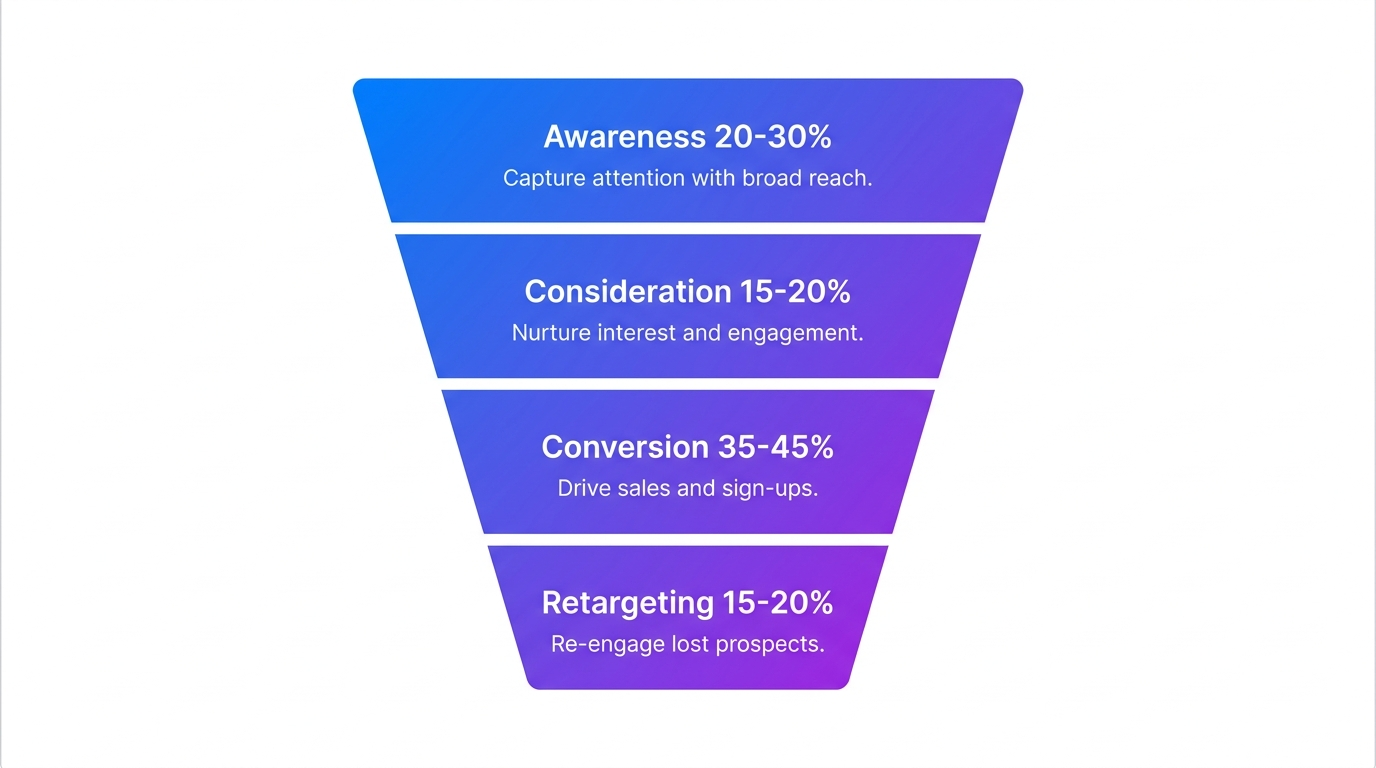
A strategy is not one campaign. It is a system that moves a stranger from never-heard-of-you to customer, and different money does different jobs along the way. The most common failure is dumping the entire budget on cold prospecting and wondering why it feels expensive. Cold traffic is the most costly place to ask for a sale.
Split your spend by stage instead. The shares below are a sane starting point for a business that already has some traffic and traction. If you are brand new with no audience, push more into awareness early, then shift toward the bottom as pixels and lists fill up.
| Funnel stage | Job it does | Typical budget share | Best-fit channels |
|---|---|---|---|
| Awareness | Reach the right cold audience | 20-30% | Paid social, YouTube, display |
| Consideration | Educate, build trust, earn the click | 15-20% | Social video, search on broad terms |
| Conversion | Capture ready-to-buy intent | 35-45% | Google Search, local service ads |
| Retargeting | Close warm visitors who did not act | 15-20% | Meta + Google retargeting |
The line that earns the most and gets cut the most is retargeting. The people who visited your site and left are the cheapest customers you will ever buy back, because they already know you. Skipping retargeting to spend more on strangers is like filling a bucket with a hole in it and blaming the tap.
Step 5: Creative and testing discipline
Targeting decides who sees you. Creative decides whether they care. On discovery platforms especially, the creative is the campaign. A brilliant audience with a boring video loses to an average audience with a scroll-stopping one.
Two rules keep this honest. First, test one variable at a time. Run the same offer with two headlines, or one headline with two images, not four fully different ads at once, so a winner actually tells you something. Second, budget for creative as a running cost, not a one-time task. Ad fatigue is real. The same image that crushed in week one quietly dies by week four as your audience stops seeing it as new. Plan on fresh creative every few weeks. This is exactly why strong Facebook and Instagram Ads are a production habit, not a set-and-forget upload, and why paid social eats more creative than search does.
And do not forget the destination. The best ad in the world dies on a slow, cluttered landing page. Your ad and your page must make the same promise, load fast on a phone, and ask for one clear action. A mismatch there is the quietest budget leak of all.
Step 6: Measure what pays you, not what flatters you
The last decision is which number you trust. Click-through rate, impressions, and cost per click feel like progress and mostly are not. They are the metrics that are easy to move and easy to fool yourself with. Judge every platform on cost per lead and cost per sale, never on cost per click. Cheaper clicks are not cheaper customers. And when you do look at return on ad spend, compare it against your own break-even rather than a benchmark you read somewhere, which is the whole argument of what is a good ROAS.
Set up conversion tracking before you launch, not after, so you can tie spend to actual booked jobs instead of guessing. Then read results on a slow clock. Checking daily and yanking budgets on a bad afternoon is how good campaigns get killed in their learning phase. Give a change a week or a meaningful number of conversions before you judge it. If you want the broader view of pulling more return out of every channel, how to improve marketing ROI connects the paid picture to the rest of your funnel.
Putting it together
A paid strategy on one page reads like this: a specific goal, the numbers that make it fundable, one primary platform chosen by intent or discovery, budget split across the funnel with retargeting protected, disciplined creative testing, and a single honest metric. Everything not on that page is a candidate for the "do not spend on this" list, which is where strategy actually lives.
How AdForce runs paid ads
We do not pick a platform and hope. We start from your goal and your customer value, size a target CPA you can defend, and put each dollar where it does the most work: Google Ads to capture demand, Meta Ads to create it, retargeting to close the near-misses, and tracking that ties spend to real leads instead of vanity clicks. Real people own the strategy; the best AI handles the optimization in between. If you want us to look at your numbers and tell you honestly where your first or next dollar should go, book a free 15-minute call.
Frequently asked questions
What is a paid advertising strategy?
It is a connected set of decisions that turns ad spend into customers profitably. A real strategy defines one specific goal, the customer value and target cost per acquisition that make it fundable, the platforms chosen by whether you are capturing or creating demand, how budget is split across funnel stages, a creative testing plan, and the single metric you judge success by. A list of platforms you advertise on is not a strategy; it is just a media buy.
How much should a small business budget for paid ads?
There is no universal number, but the right way to set it is against the value of a customer, not a gut feeling. If one new customer is worth $1,500 and your funnel reliably turns paid leads into sales at a healthy cost, you scale up. Start small, prove your cost per lead and cost per sale on one platform, then expand once the math clearly works. Spreading a small budget across four platforms at once is the most common way to waste it.
Should I start with Google Ads or Facebook Ads?
It depends on your goal. Choose Google when you need to capture existing demand from people actively searching, which is the fastest route to calls and bookings. Choose Facebook and Instagram when you need to create demand, launch something new, or reach people who fit your customer profile but are not searching yet. Most businesses that can afford it eventually run both, with social filling the funnel and search closing it.
What is a target CPA and how do I set one?
CPA is cost per acquisition, the amount you pay to win one customer. To set it, start from your average customer value over the whole relationship, not just the first sale. A common rule is to spend no more than 20 to 30 percent of first-purchase value to acquire, and more if you have strong repeat revenue. Knowing this number is what lets you keep a campaign running when a competitor without the math panics and turns it off too early.
How should I split my ad budget across the funnel?
A sane starting split for a business with some existing traction is roughly 20 to 30 percent on awareness, 15 to 20 percent on consideration, 35 to 45 percent on conversion, and 15 to 20 percent on retargeting. Protect the retargeting budget in particular, because people who already visited your site are the cheapest customers you will ever buy back. Brand-new businesses should weight awareness more heavily at first, then shift toward the bottom of the funnel as their audiences and pixels fill up.
Which metrics actually matter in paid advertising?
Cost per lead and cost per sale. Click-through rate, impressions, and cost per click feel like progress but are easy to move and easy to fool yourself with. Cheaper clicks are not cheaper customers. Set up conversion tracking before you launch so you can tie spend to real booked jobs, then judge campaigns on a slow clock rather than reacting to a single bad day.
How often should I refresh my ad creative?
Plan on fresh creative every few weeks, especially on paid social. Ad fatigue is real: the same image or video that performed well in week one quietly loses effectiveness by week four as your audience stops registering it as new. Treat creative as an ongoing production cost, not a one-time upload, and test one variable at a time so you can tell what actually drove the change.
Why are my ads getting clicks but no sales?
Usually the traffic, the destination, or the follow-up. Discovery clicks from social come from browsing, not active buying, so they need more nurturing than a search click. A slow or cluttered landing page that does not match the ad's promise kills conversions. And leads that never get a fast, consistent follow-up rarely become customers. Fix the page and the follow-up before you blame the platform.