What Is a Good ROAS? Benchmarks vs Your Break-Even
Quick answer: What is a good ROAS? There is no universal number, because ROAS ignores the thing that decides whether you make money: your margin. Your break-even ROAS is one divided by your gross margin, so a business running 40 percent margin breaks even at 2.5x while a business running 80 percent breaks even at 1.25x. A good ROAS is comfortably above your own break-even, usually 40 to 50 percent above it once fixed costs are covered. Industry ranges are worth knowing as a sanity check, but for anything with a sales cycle, cost per booked job is the number that actually runs the business.
Published 2026-09-18 · Paid Ads · by AdForce

Someone in a Facebook group posts that their ROAS is 8. Yours has been sitting at 3.1 for a month and you have been quietly worried about it ever since. Before you change a single campaign, here is the part nobody in that thread mentioned: from those two numbers alone, you cannot tell which of you is making money.
It is entirely possible that they are losing money at 8 and you are profitable at 3.1. That is not a trick statement. It follows directly from what ROAS does and does not measure.
The reframe: ROAS is a ratio, and the profit lives in the part it leaves out
Return on ad spend is revenue divided by ad spend. Spend 1,000 dollars, generate 3,100 dollars of revenue, and your ROAS is 3.1. That is the whole formula, and the whole problem.
It says nothing about what that revenue costs you to deliver. A 3.1x ROAS on a service with 70 percent gross margin is a good business. The same 3.1x on a product with 20 percent margin loses money on every single sale, and the more you spend the faster you lose it.
So the honest version of the question is not "what is a good ROAS". It is "what is a good ROAS for a business with my margin", and that has an exact answer:
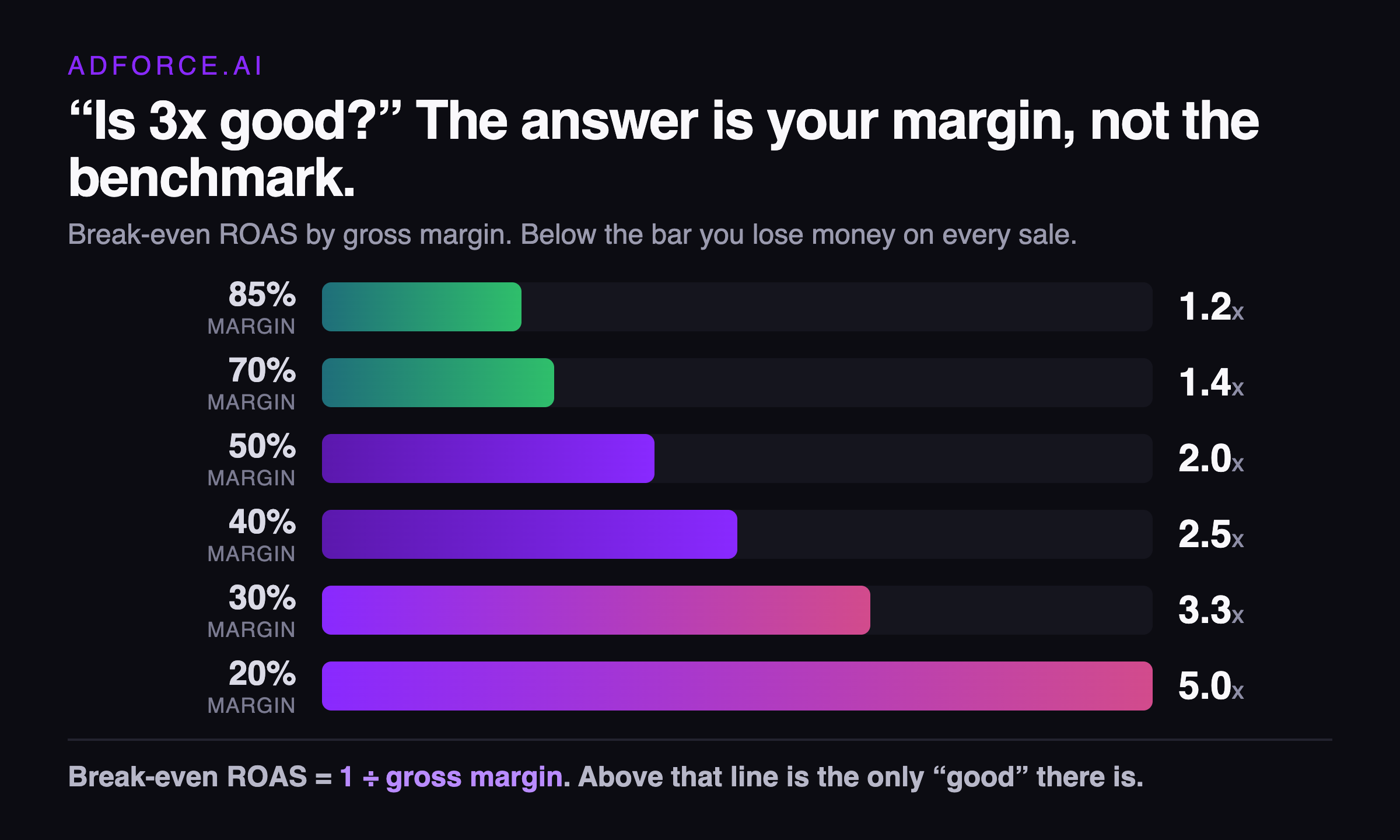
Break-even ROAS = 1 ÷ your gross margin.
That is arithmetic, not opinion, and it is the number every benchmark article should start with and almost none do.
| Your gross margin | Your break-even ROAS | Where "good" realistically starts |
|---|---|---|
| 20% | 5.0x | around 7x |
| 30% | 3.3x | around 4.8x |
| 40% | 2.5x | around 3.5x |
| 50% | 2.0x | around 3x |
| 70% | 1.4x | around 2x |
| 85% | 1.2x | around 1.7x |
The third column needs its reasoning stated, because it is a working rule rather than a law. Break-even covers the cost of delivering the thing you sold. It does not cover the van, the office, the software, the salaries, the agency fee, or the profit you are actually in business for. Targeting roughly 40 to 50 percent above break-even is a working rule that leaves room for overhead and profit. Your own fixed-cost load may push it higher or lower, and you should work it out rather than inherit it.
Step one: calculate your own break-even before you look at a single benchmark
Take one thing you sell. Not an average of everything, one real job or one real product.
- Write down the price you charge.
- Subtract everything it costs you to deliver it. Materials, subcontractors, labor on that job, payment fees, shipping, returns. Not rent, not salaries, not your ad budget.
- Divide what is left by the price. That is your gross margin.
- Divide one by that number. That is your break-even ROAS.
A remodeler selling a 24,000 dollar kitchen with 14,400 dollars of materials and trades in it is running 40 percent margin, so ads have to return 2.5x before a dollar of profit exists. A law firm where delivery is essentially the team's time might be at 75 percent, so 1.33x is break-even and 2x is a good month.
Two businesses, same 2.5x ROAS. One is at break-even, the other is well into profit. That is the entire reason a universal benchmark cannot exist.
Step two: know which ROAS you are actually looking at
Before you trust the ratio, find out which one your dashboard is reporting, because there are three and they disagree.
- Platform-reported ROAS. What Meta or Google shows in the interface, using its own attribution. It includes view-through conversions, it credits itself generously, and if you run both platforms they will together claim more revenue than you actually took.
- Blended ROAS. Total revenue in the period divided by total ad spend in the period. Crude, ignores organic entirely, and it is the only one that cannot be inflated by attribution. Use it as the sanity check.
- Actual, attributed-in-your-CRM ROAS. Revenue tied to a real customer record that came from a real campaign. This is the one worth acting on, and it requires that your leads land somewhere that records where they came from.
If your platform ROAS says 4x and your blended ROAS says 1.8x, you do not have a 4x campaign. You have an attribution gap, and it is usually made of repeat customers, brand searches and people who would have bought anyway. Our guide on improving marketing ROI covers where the rest of the leakage tends to hide.
Step three: read the industry ranges as a sanity check, never as a target
With break-even established, the ranges become useful, because you can see immediately whether your sector's economics put you above or below your own line. These are ranges with their reasoning stated rather than a single figure, because the honest spread within any one industry is wider than the gap between industries.
| Business type | Typical gross margin, and why it sits there | Break-even ROAS | What actually decides the number |
|---|---|---|---|
| Ecommerce, physical product | 30 to 50%, because landed product cost plus shipping and returns usually eats half or more of the order value | 2.0x to 3.3x | Repeat purchase rate. A 2x first order is fine if they buy four times a year, and fatal if they buy once. |
| Home services (roofing, remodeling, HVAC) | 25 to 45% on the job, because materials and subcontracted labor usually take over half the job price | 2.2x to 4.0x | Job value and close rate. Most of the conversion happens on the phone, where the platform cannot see it. |
| Professional services (law, accounting, consulting) | 60 to 80%, because delivery is mostly the team's own hours and very little is bought in | 1.25x to 1.7x | Case or client value, and how long the cycle is. Ad-platform ROAS is often meaningless here. |
| SaaS and subscription | 70 to 85%, because hosting and support are a small fraction of what the subscription charges | 1.2x to 1.4x on first payment | Lifetime value. Judging a subscription on the first month's ROAS will shut down profitable spend. |
| Real estate acquisition and investing | The spread on the deal, not a percentage of a price, because the purchase price is the cost | Deal-by-deal | One contract can pay for a quarter of spend, so monthly ROAS swings violently and means very little. |
These are working ranges, not survey figures: each one is the arithmetic of what that kind of business has to buy in before it can deliver. Check yours against your own numbers rather than adopting the row. And read the table for the fourth column, not the third. In every row, the thing that decides whether the campaign works sits outside the ad account.
Step four: for anything with a sales cycle, cost per booked job beats ROAS
This is the part that matters most for the businesses we work with, and it is worth being concrete.
Our own keyword research puts emergency roof repair at roughly 5,400 searches a month at a cost per click near 48 dollars. That figure is on our SEO for roofers page and it comes from our own data pull, not from a rumour. Now run it forward with assumptions you can swap for your own:
- 48 dollars a click, and a landing page that converts 10 percent of that traffic, gives you a lead at about 480 dollars.
- Close 40 percent of those leads and a booked job costs about 1,200 dollars.
- On a 12,000 dollar replacement at 35 percent margin, that job carries 4,200 dollars of gross profit.
That is a healthy campaign, and its ROAS is 10x. Change one input, the landing page converting at 4 percent instead of 10, and the same clicks produce a 3,000 dollar cost per booked job on the same 4,200 dollars of profit. Still positive, barely, and now extremely fragile.
Notice what moved. Not the ad account. The click price was identical in both versions. The page a click lands on does the converting whether the click was paid or organic, which is why the roofing sites we build, like Green Apple Roofing's, put a specific page behind each specific job.
The reason cost per booked job wins for these businesses is simple: the sale finishes on a phone call or at a kitchen table, days or weeks later. The platform never sees it. If you judge on platform ROAS you will switch off the campaigns that produce your best jobs, because their conversions happen somewhere the pixel cannot follow.
Step five: the four levers that move ROAS, and three of them are not in the ad account
When the number is too low, almost everyone reaches for the same lever first, and it is the weakest one.
- Margin and price. The most direct lever and the least used. Raising price by 10 percent on a 40 percent margin business moves break-even ROAS from 2.5x to about 2.2x, permanently, on every campaign you will ever run.
- Average job value. Bundling, upsells, and simply quoting the better version of the job. Doubling the ticket doubles ROAS on the same ad spend without touching a bid.
- Landing page conversion rate. The highest-leverage number in most accounts, and usually the most neglected. Going from 4 to 8 percent does exactly the same thing to your ROAS as halving your click cost, and it is far more achievable. How to calculate and improve your PPC conversion rate is the full method.
- Speed and quality of follow-up. A lead answered in two minutes and one answered the next morning are not the same lead, and the difference shows up as ROAS. This is what AI marketing automation is actually for.
Creative is the fifth, and it is real, but it is the one that decays. The first four compound.
Only after those do you touch bids, budgets and targeting. If you are still deciding which platform to put the money on in the first place, Google Ads versus Facebook Ads works through that choice.
When a low ROAS is the right answer
Three cases where deliberately accepting a worse ROAS is the better decision, because they come up constantly and nobody says them out loud.
| Situation | Why a lower ROAS is correct |
|---|---|
| You are buying a first order to win a repeat customer | Break-even on order one is fine when order two through five carry no ad cost at all |
| You are entering a new town or service line | You are paying for data and for a foothold, and both are assets that outlive the campaign |
| Your competitor just stopped advertising | The auction is cheaper than it will be again. Taking share at a thinner margin is the move |
And the mirror image: a very high ROAS is often a sign you are underspending. If you are sitting at 12x and profitable, the campaign is not a triumph, it is a queue of customers you are choosing not to serve. Widen it until the ROAS falls toward your target, because the total profit is what pays you, not the ratio.
Putting it together
- A good ROAS is the one above your break-even, and break-even is one divided by your gross margin.
- Calculate it on one real job, not on a company-wide average that hides the products that lose money.
- Know which ROAS your dashboard is reporting. Platform, blended and CRM-attributed will not agree, and only one of them is safe to act on.
- Industry ranges are a sanity check, and within any one industry the spread is wider than the gap between industries.
- For anything sold on a phone call, track cost per booked job. Platform ROAS cannot see the part where the sale happens.
- Three of the four levers that move the number are outside the ad account: margin, job value and the landing page.
- A very high ROAS usually means you are underspending. Total profit pays you, not the ratio.
That is the same sequence we use to set up an ad account, whether it is home improvement or professional services: establish break-even from the real margin first, instrument the follow-up so a booked job can be traced back to the campaign that produced it, then fix the landing page before touching the bids. Real strategists own the plan; the best AI does the heavy lifting in between, which is why the reporting keeps tying back to jobs rather than to a screenshot of a dashboard.
If you want an honest read on whether your current spend is above or below your own break-even, book a free 15-minute call. We will work it out with you on the call, and tell you plainly if the answer is that your margin, not your marketing, is the problem. Our Google Ads and Facebook and Instagram Ads services run the whole loop when you would rather hand it over.
Frequently asked questions
What is a good ROAS?
The one above your own break-even, which is one divided by your gross margin. At 40 percent margin you break even at 2.5x, so a good ROAS starts around 3.5x once fixed costs are covered. At 80 percent margin you break even at 1.25x and 2x is a strong result. Any single number quoted without reference to margin is not answering the question.
How do I calculate break-even ROAS?
Divide one by your gross margin expressed as a decimal. A 25 percent margin gives a break-even ROAS of 4.0x, a 50 percent margin gives 2.0x, and an 80 percent margin gives 1.25x. Calculate the margin on one real job or product, subtracting only the cost of delivering that specific thing, not your rent or salaries.
Is a 3x ROAS good?
It depends entirely on your margin. On a 50 percent margin business, 3x is comfortably profitable. On a 20 percent margin business, 3x loses money on every sale, because break-even there is 5x. The same ratio is a good month for one business and a slow bleed for another.
Is a 2x ROAS profitable?
Only if your gross margin is above 50 percent, since 2x is exactly break-even at 50 percent. Below that you are subsidizing each sale. Above it, 2x leaves a real contribution, and for a subscription business or a professional services firm 2x can be an excellent number.
Why is my platform ROAS higher than my actual revenue suggests?
Because platforms use their own attribution and credit themselves generously, including view-through conversions and customers who would have bought anyway. Run both platforms and they will jointly claim more revenue than you actually took. Compare against blended ROAS, which is total revenue divided by total ad spend, and investigate the gap.
Should home-service businesses use ROAS at all?
Use it, but do not steer by it. Most of the conversion happens on a phone call the platform cannot see, often days after the click, so reported ROAS systematically understates campaigns that produce your best jobs. Cost per booked job, measured in your CRM, is the number that should drive decisions.
What is the difference between ROAS and ROI?
ROAS is revenue divided by ad spend and ignores every other cost. ROI is profit divided by total investment and accounts for delivery, overhead and the cost of the marketing itself. ROAS is useful for comparing campaigns against each other; ROI is what tells you whether the business made money.
My ROAS is very high. Is that good?
Usually it means you are underspending. A campaign sitting at 10x or more is typically running on a narrow, cheap slice of demand while the rest goes to competitors. Increase budget deliberately and watch the ratio fall toward your target. Total profit is what pays you, and it almost always rises as ROAS falls from very high toward your break-even plus margin.
Does a new campaign need time before I judge its ROAS?
Yes, and the length depends on your sales cycle rather than on a fixed number of days. A campaign should run until it has produced enough closed sales to be measured, which for a high-value considered purchase can be six to eight weeks. Judging week one of a remodeling campaign on ROAS tells you almost nothing.