Stop Renting Roofing Leads. Own the Search Result.
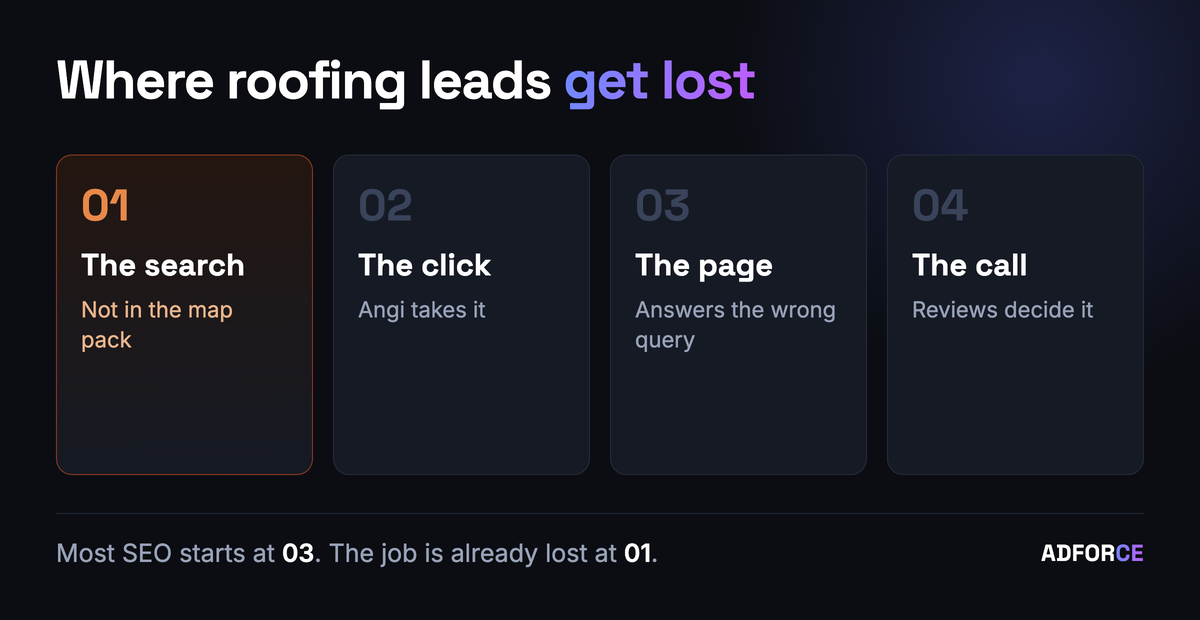
A roof replacement is a five-figure job. Aggregators sell that same lead to four of your competitors at once. Ranking for it yourself means the homeowner calls one number, and it is yours.
Quick answer: SEO for roofers means earning the searches that produce roofing jobs instead of buying them: emergency repair, roof replacement cost, and the commercial flat-roof work most contractors ignore.
Read the full answer
In practice that is three things running together - a hub-and-spoke content cluster published twice a week, a page for every town you genuinely serve with real local detail on it rather than a spun template, and a Google Business Profile kept active. It is a compounding asset rather than a switch, and it is measured in quarters, not weeks.
What roofing SEO actually has to solve
- The map pack is the whole game: Roof searches are urgent and local. Three listings sit above every organic result, and the homeowner with an active leak rarely scrolls past them. We optimize for the pack first, the blue links second.
- Storm demand arrives in days, not months: A hailstorm rewrites your search volume overnight. Pages for storm damage, emergency repair and insurance claims have to be already ranking when it hits - built in the quiet season, not after.
- Insurance work and retail work are different searches: Someone filing a claim asks different questions than someone paying out of pocket. One page cannot serve both. We separate them so each ranks for its own intent.
- You are competing with aggregators, not just roofers: Angi, HomeAdvisor and Networx outrank most contractors, then sell your lead back to you. The strategy is to rank beside them for the terms they cannot personalize: your city, your crew, your work.
- Reviews are a ranking factor and a closing tool: Volume, recency and keyword content of reviews all move map-pack position. We automate the ask so it happens on every job instead of when someone remembers.
- AI assistants are already recommending roofers: Homeowners ask ChatGPT and Google AI Overviews who to call. Those answers cite sources, and almost no roofing contractor has done the structured-data work needed to be one of them yet.
What actually moves a roofing company up the page
The opportunity most roofers walk past
Ask a roofing contractor what they want to rank for and you will hear roof repair and roofing company near me. Those are the most contested terms in the trade, and they are contested by every roofer in the county at once.
If you run more than one trade rather than specialising in roofs, the shape of the work changes and our SEO for contractors page covers that version instead. If you buy houses rather than work on them, real estate investor marketing is the acquisition-side version.
The work that is genuinely under-served is commercial. Flat roofs, TPO, ponding, warranty documentation, the inspection a facility manager needs before budgeting. Fewer contractors are certified for it, far fewer write about it, and the job values are larger. For Green Apple Roofing - who hold both GAF Master Elite and GoldElite Commercial, a rare pairing - we made commercial the standing focus of every month's calendar rather than an afterthought: flat-roof cost, inspection, emergency leak response, maintenance.
The principle underneath it: a specific page about a specific job beats a general page about roofing.
Town pages: the thing everyone does badly
Most roofing sites either skip local pages entirely or generate a hundred of them by swapping the town name into one template. Google treats the second as duplicate content, which is worse than not having them.
We built 74 town pages for Green Apple, and the reason they work is what is on them. Every town carries a real coastal-exposure classification - ocean, bay or inland - because salt air genuinely changes how a roof fails in Monmouth and Ocean County. Every town links to its true geographic neighbours, not a random internal list. And every town has one factually specific sentence about its housing stock that could not be said about anywhere else.
That detail is the entire difference between a local page that earns its place and a hundred that dilute the site. It is also the slowest part of the build, which is why most agencies skip it, and a large part of why a realistic SEO timeline starts later than most contractors expect.
Two articles a week, published apart
Green Apple runs on a locked monthly calendar of eight pieces, planned from keyword data before a word is written. Each piece gets a documentary photograph from the crew's own job archive and a designed infographic, and each links into the hub it belongs to.
One detail matters more than it sounds: we stagger the publishing. Several pieces are often built in the same week, but they go live days apart. A site that publishes two articles on one day and nothing for the next two weeks reads as a batch upload. A site publishing steadily reads as an active business, and that is what gets crawled more often.
Earning the clicks that are expensive to buy
Emergency roof repair runs roughly 5,400 searches a month at a cost-per-click near $48. At those prices a handful of clicks a day is a serious advertising line item. Ranking for it is not free either - it costs months of content - but the asset does not switch off when you stop paying.
This is the honest comparison to make before starting. Paid gets you volume on Monday. Organic costs more upfront in time and less every month after. Most roofers should run Google Ads for emergency terms while the content builds, then reduce spend as organic calls arrive - not run both flat out forever. We rank every channel available to a trade business, including the aggregators, in our guide to lead generation for contractors, and the ordering is by cost per booked job rather than cost per lead. For replacement work, where the homeowner is not searching yet, paid social does a different job, and we set out the mechanics in our playbook for home services.
What the first few months actually look like
Here is the part worth being straight about. A new roofing site does not arrive fully formed. In the early months the homepage surfaces widely for broad terms it cannot yet win, while the pages that actually earn clicks are the narrow ones - a specific town, a specific commercial job. Volume looks impressive before it means anything.
That is the normal shape, not a warning sign, and it is why we judge the programme at six months rather than six weeks. What matters early is whether the right kind of page is moving, not the headline number.
The part almost nobody is doing yet
Homeowners increasingly ask ChatGPT or read Google's AI Overviews instead of scrolling results. Those systems cite sources, and being citable is a separate discipline - structured data, answer-first writing, consistent business information. Almost no roofing contractor has done any of it, which is why it is worth doing now. That is our GEO and AI search work, and the background is in our explainer on getting recommended by ChatGPT.
The underlying local-SEO mechanics - profile, citations, reviews, map pack - are the same ones in our local SEO programme and our guide for local businesses. This page is that programme aimed at roofing.
What we will not promise
We will not promise a number one ranking on a date. What we will show you is where you rank today, who is above you, what is keeping you below them, and roughly how long it took a comparable account to move. Then you decide whether the maths works.
What you get, and what it looked like on a real account
- Own every town you serve: A page for every town you genuinely serve, each carrying real local detail rather than a swapped-in name. We built 74 of them for one New Jersey contractor.
- Win the commercial jobs: Bigger tickets, fewer contractors certified for the work, and almost nobody writing about it. We make commercial the standing focus, not an afterthought.
- Earn the $75 clicks: "24 hour roof repair" costs $75.22 a click to buy on Google Ads. If your profile already carries the Open 24 Hours attribute, that is an asset nobody is using.
- Outrank the lead resellers: Angi sells one homeowner to four contractors. A ranking is yours alone, and it does not stop when you stop paying.
- Publish twice a week, forever: Eight pieces a month off a locked calendar, each one linking back into the pages that actually sell.
- Prove it from day zero: A local search grid and rank tracker running before the first page ships, so month three is measured against month zero instead of a memory.
Client work - Green Apple Roofing, New Jersey
A GAF Master Elite and GoldElite Commercial contractor, roofing New Jersey since 2008. We built and run their search presence: a new site with a page for every town they genuinely serve, a commercial-first content calendar, and two pieces published every week against it.
Frequently asked questions
How is this different from your general local SEO service?
The engine is the same; the targets are not. A roofing account is built around storm seasonality, the split between insurance and retail jobs, and competing with lead aggregators rather than only with other contractors. If you want the general service across any local trade, that is our Local SEO page.
How long before a roofing site ranks?
The Google Business Profile responds fastest, usually inside the first month or two, because the profile is quicker to re-evaluate than a domain. Pages take longer. Expect the first meaningful movement at two to three months, and judge the programme at six. Anyone promising a number one ranking on a date is either guessing or describing a term so obscure that winning it is worthless.
Is SEO worth it if I already buy leads from Angi or HomeAdvisor?
Those leads never stop costing money and are sold to several contractors at once. A ranking is an asset you keep. Most roofers we work with run both for the first few months, then reduce aggregator spend as organic call volume replaces it.
Do I need a page for every town I serve?
Yes, if they are built properly. We built 74 town pages for a New Jersey roofing client and they rank, because each one carries genuinely local detail: a coastal salt-exposure classification, its true neighbouring towns, and a factual line about that town specifically. What fails is the other approach, generating a hundred pages by swapping the town name into one template. Google reads that as duplicate content and it does more harm than having no local pages at all.
What about storm season - can you get us ranking before it hits?
That is the point of building storm and hail pages in the off-season. A page published the week after a storm is competing from zero against pages that have been indexed for months.
How much does roofing SEO cost?
It depends on how many towns you are competing in and how strong the incumbents are. A single-town contractor is a materially smaller build than one covering a metro with eight suburbs. We quote after the audit, once we can see what is actually required, rather than before.
What if I already have a website - do I need a new one?
Usually not. Most roofing sites need structural work rather than replacement: pages that target one query each instead of one page trying to serve everything, faster load on mobile, and proper local schema. We tell you honestly if a rebuild is genuinely cheaper than repair.
Do reviews really affect rankings, or just trust?
Both, and the ranking effect is larger than most contractors expect. Volume, recency and the words inside the review all feed map-pack position. A steady trickle of recent reviews outperforms a large number that all arrived two years ago.
Can you help if I work mostly on insurance and storm claims?
Yes, and that work needs its own pages. Someone filing a claim searches differently from someone paying out of pocket, asks different questions, and needs different reassurance. Serving both from one page means ranking well for neither.