Lead Generation for Contractors: 8 Channels Ranked
Quick answer: Ranked by cost per booked job rather than cost per lead, the order for most contractors is: referrals and repeat customers, then the Google Business Profile and map pack, then service and town pages on your own site, then Local Services Ads, then Google Search ads, then retargeting, then Meta ads, and last, shared lead marketplaces. That last one is where most contractors start, because it has the cheapest leads. It produces the most expensive booked jobs, because the same lead was sold to three other contractors at the same moment and you end up winning it on price.
Published 2026-09-22 · Local SEO · by AdForce

You paid for four leads last week. One was outside your service area. One wanted a price over the phone and hung up when you would not give one. One never picked up. The fourth you quoted, and they went with someone 900 dollars cheaper who called them eleven minutes before you did.
That is not a bad week. For a contractor buying shared leads, that is an ordinary week, and it is why lead generation for contractors is almost never a question about getting more leads.
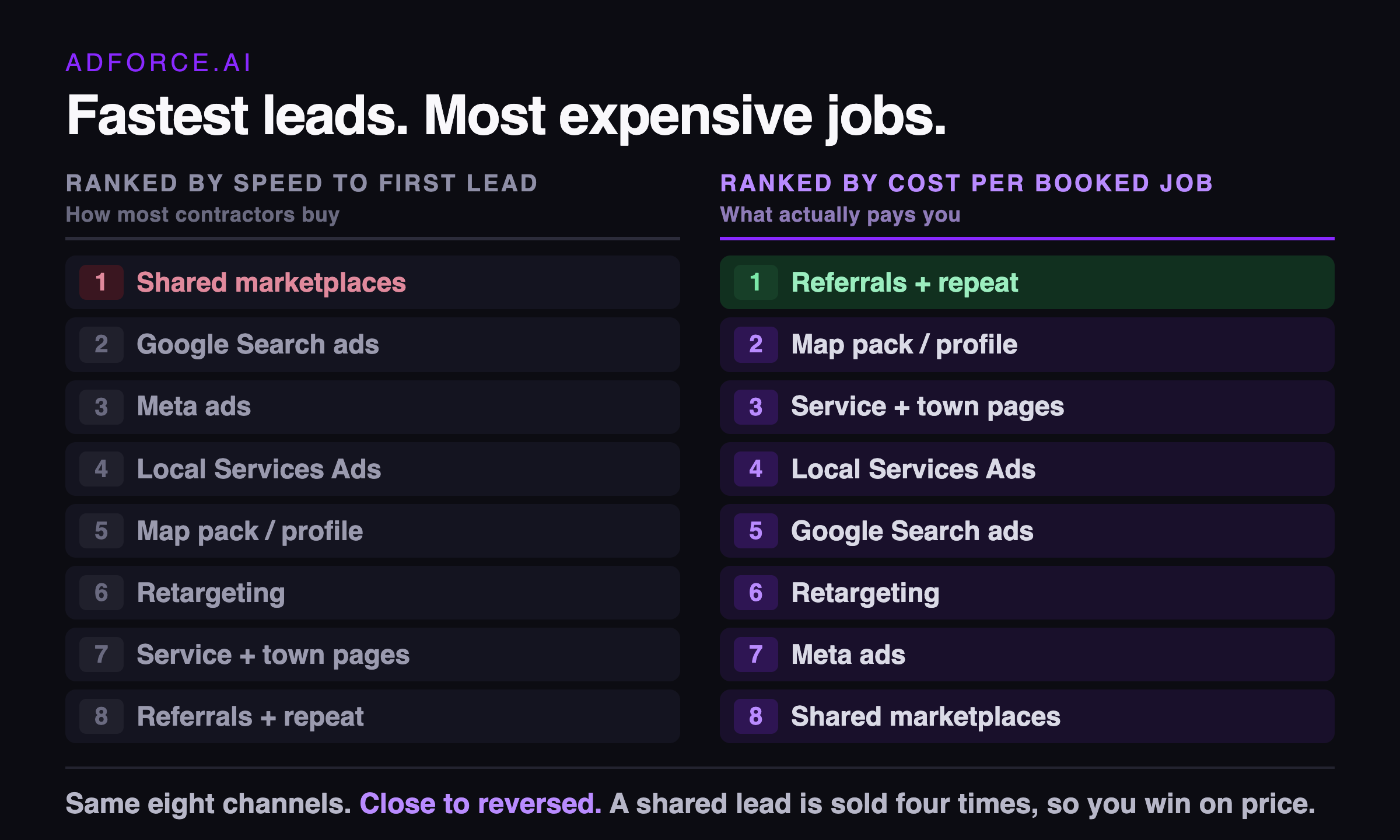
The reframe: rank your channels by cost per booked job, and the order flips
Every contractor knows roughly what a lead costs, because someone invoices them for it. Very few know what a booked job costs, because that number is spread across a lead fee, a quote you drove out to give, and a close rate nobody tracks.
Those two numbers rank your channels close to the reverse of each other.
A shared marketplace lead can cost 35 dollars. Treat that as the middle of a range, not a price list: trade, region and whether the lead is exclusive move it more than anything else, from the low twenties for a small repair in a cheap market to well over a hundred for an exclusive lead on a high-value job. The structural part is what happens next. The same lead is sold to four contractors at once, yours included, so at best one in four wins it — a 25 percent close rate before you subtract the ones nobody can reach, the ones outside your area, and the ones who only ever wanted a price over the phone. Strip those out and 10 percent is the number most contractors actually live with, and the ones they do win they won by being cheapest. Ten leads at 35 dollars is 350 dollars for one job you discounted to get. Call that 350 dollars plus the margin you gave away, and it stops looking cheap.
A job that comes from your own Google Business Profile cost you nothing per lead. The caller found you, read your reviews, and called you specifically. Close rates on those run far higher, and nobody asked you to match a price.
| How you rank them | Order you get |
|---|---|
| Speed to first lead (how most contractors buy) | Marketplaces, Search ads, Meta ads, LSAs, map pack, retargeting, organic, referrals |
| Cost per booked job (what pays you) | Referrals, map pack, organic, LSAs, Search ads, retargeting, Meta ads, marketplaces |
The two lists run close to the reverse of each other: the channels that hand you a lead soonest are the ones that produce the most expensive booked jobs. That is the whole article, and the rest is what to do about it.
Step one: work out your own cost per booked job, once
You need three numbers per channel, and you can get them from your calendar and your invoices without any software.
- What you spent on that channel last quarter. Ad spend, lead fees, retainer, all of it.
- How many jobs you actually booked from it. Not leads. Jobs with a signed number on them.
- Divide.
Then set it against your average job value and margin. A 1,200 dollar cost per booked job is excellent on a 14,000 dollar kitchen and catastrophic on a 600 dollar repair. If that comparison is unfamiliar, what a good ROAS actually is works through the break-even arithmetic properly, and it is the same math.
Do this for one quarter and you will usually find one channel you have been defending out of habit.
Step two: the ranking, with what each one is actually for
1. Referrals and repeat customers
The cheapest booked job you will ever get, and the one contractors systematically under-work because it feels like it should happen by itself.
It does not. It happens when somebody asks. A follow-up sequence after every completed job that asks for the review and mentions that you take referrals turns a passive channel into a deliberate one, and it costs you nothing per job. If you do not have that sequence running today, build it before you buy another lead.
Do this first, always. It is the only channel where your marginal cost is zero and you are usually the only contractor being quoted, which is why nothing else on this list closes anywhere near as well.
2. The Google Business Profile and the map pack
The fastest-moving free asset a contractor owns, and usually the most neglected. Someone searching "roof repair near me" from two towns over sees three businesses. You are either one of them or you are not in that conversation.
The levers are the primary category, complete services and service areas, a steady flow of reviews, and real photos. We put the profile audit first on every engagement for exactly this reason. With Green Apple Roofing in New Jersey, the first deliverable was not a line of website copy, it was the Business Profile, because it is the fastest clock and there was no reason to make it wait on the site build.
That clock is short for a structural reason. Category, services and service-area edits are re-crawled within days, while the parts that actually move you inside the pack — review volume and how recent those reviews are — accumulate over weeks. So a neglected profile in a thin market can move in two weeks, and a contested suburb takes closer to two months. Two to eight weeks is the honest band, not a promise.
How to rank higher on Google Maps is the full method, including why your own ranking looks different from your office than from anywhere else.
3. Service pages and town pages on your own site
Slowest to build, cheapest to run once it is built, and the only channel on this list that is genuinely yours — Green Apple's build ran to 74 town pages, each written to stand on its own, plus 35 old URLs mapped to permanent redirects so years of history were not thrown away. What makes that produce rather than just exist is a subject of its own, and we take it apart trade by trade on SEO for contractors and SEO for roofers, because a researched kitchen and an emergency roof leak do not behave the same way.
4. Local Services Ads
Google's pay-per-lead product with the Google Guaranteed badge. It sits above everything else on the page, and you pay per lead rather than per click.
It is genuinely good for contractors, with two caveats. You are still competing on response speed, because the lead goes to several businesses. And the badge requires background checks and license verification, which takes time to set up and is worth doing properly.
5. Google Search ads
Expensive per click and high intent. Keyword research we ran for a New Jersey roofing client puts emergency roof repair at roughly 5,400 searches a month at a cost per click of 48.60 dollars, which tells you two things at once: there is real demand, and it will not be cheap.
Search ads earn their place when you need work this month, when you are proving a new service line before committing to a year of content, or when you want to hold the top of a page you are still climbing organically. Treat them as the fast lane, not the destination. What decides whether they are profitable is almost never the bidding, it is the page the click lands on.
6. Retargeting
Cheap, small in volume, and quietly one of the best-performing lines in a contractor's account, because the audience already visited your site. On a considered purchase where a homeowner takes six weeks to decide, being present across those six weeks is worth more than it costs. It cannot generate demand on its own, so it never ranks higher than sixth, and it should almost always be running.
7. Facebook and Instagram ads
Cheap leads, low intent, and a wide gap between the two. Meta is where you create demand rather than capture it, which for a contractor means storm damage, seasonal work, and jobs homeowners did not know they wanted until they saw the result.
It works when the offer is concrete and the follow-up is fast, and it produces expensive booked jobs when either is missing. Our Facebook and Instagram ads playbook for home services is the detailed version.
8. Shared lead marketplaces
Angi, Thumbtack, Houzz and the rest. Last on this list, and first place most contractors start.
Be fair to them: they work, they start today, and for a new business with no reviews, no ranking and no referral base, they are a legitimate way to get the first jobs on the board. The problem is structural, not moral. The same lead is sold to four contractors at once, so you compete on response time and price, both of which cost you margin. And you are renting the customer relationship. Stop paying, and it stops, with nothing accumulated.
The pattern that works: keep buying them while the channels above mature, then taper as your own phone starts ringing. Do not quit cold — cut the spend as the cheaper channels prove, in booked jobs, that they are producing.
Step three: the trade nobody states out loud
Look at the ranking again and notice that it runs close to the reverse of speed.
| Channel | Cost per booked job | Time to first job |
|---|---|---|
| Referrals, repeat | Lowest | Immediate, but not on demand |
| Map pack, Business Profile | Very low | 2 to 8 weeks |
| Service and town pages | Low, and falling | 3 to 6 months |
| Local Services Ads | Moderate | Days, after verification |
| Search ads | Moderate to high | Days |
| Retargeting | Low, tiny volume | Needs traffic first |
| Meta ads | Variable, high without follow-up | Days |
| Shared marketplaces | Highest | Today |
That is the real decision, and it is not "which channel is best". It is run the fast expensive ones to pay this month's bills while the slow cheap ones are built underneath, then taper the expensive ones as the cheap ones start producing. How long SEO actually takes sets honest expectations for the bottom half of that table, because month three is where most contractors give up on it, roughly one month before it starts working.
Step four: the multiplier that beats the channel choice
Here is the uncomfortable part. Speed of response changes your cost per booked job more than switching channels does.
Every shared lead you buy is a race, and so is half of everything else. A homeowner with a leak calls three numbers and books the first one that answers with a real human. If you are on a roof when the phone rings, you lose that race no matter which channel sent it.
None of this is about buying more leads. It is about not wasting the ones you already paid for:
- Answer inside five minutes, or have something that does. Missed-call text-back is the single highest-return automation in the trades and it takes an afternoon to set up.
- Follow up more than twice. Most contractors quote once and stop. The job often goes to whoever was still there in week three.
- Ask for the review every time, which feeds channel one and channel two at once.
AI marketing automation for local businesses is the mechanism behind all three, and it is the cheapest improvement available to most contractors, because it multiplies every channel above it at the same time.
Step five: stop reporting on leads
If you take one operational change from this, make it the report.
A monthly report that says "47 leads" is unreadable. Written the other way, the same month reads like this — the figures are an illustration, not a benchmark, and the last line is simply the arithmetic from the top of this piece:
Eleven booked jobs. Four from the map pack at effectively no cost. Three from Search ads at 640 dollars each. Two referrals. Two from Angi at 350 dollars each, which is ten 35-dollar leads for every one that closed.
Same underlying data, entirely different decision: that report tells you what to fund next month and what to cut, and the lead count does not.
Ask whoever sends your report to write it this way. If nobody can tell you which source a booked job came from, that is itself the finding, and it is the reason most contractors cannot name the line they should cut first.
Putting it together
- Rank on cost per booked job, not cost per lead. The two lists run close to the reverse of each other.
- Referrals and the Business Profile are the cheapest work you will ever book, and both are usually under-worked.
- A page per job and a real page per town is what makes organic produce, and thin templated town pages actively hurt.
- Marketplaces are a legitimate start and a bad finish, because the lead is sold several times and you win it on price.
- The ranking runs close to the reverse of speed. Fund the slow channels with the fast ones, then taper.
- Response time moves your cost per booked job more than changing channels does.
- Report booked jobs by source. A lead count cannot tell you what to cut.
That is the same sequence we run for contractors and roofers: the Business Profile first because it moves fastest, the service and town pages underneath it, paid holding the top of the page while that matures, and the follow-up automated so none of it leaks at the last step. Real strategists own the plan; the best AI does the heavy lifting in between, which is why the cadence holds instead of slipping in a busy season.
If you want to know what a booked job actually costs you by channel right now, book a free 15-minute call. We will work through your last quarter with you and tell you honestly which line to cut first, even if the answer is that you do not need us yet. For the trade-specific version, start with SEO for roofers or SEO for contractors, and our local SEO service runs the whole loop when you would rather hand it over.
Frequently asked questions
What is the best lead generation for contractors?
Ranked by cost per booked job, referrals and repeat customers come first, then the Google Business Profile and map pack, then service and town pages on your own site. Those three produce the cheapest work but take the longest to build. Local Services Ads and Google Search ads produce jobs fastest, and shared lead marketplaces produce the most expensive booked jobs despite having the cheapest leads.
Are Angi and Thumbtack worth it for contractors?
They are a reasonable way to get the first jobs on the board when you have no reviews, no ranking and no referral base. The structural problem is that the same lead is sold to four contractors at once, so you compete on response speed and price and give away margin to win. Use them as a start rather than a finish: keep buying while your own channels mature, then taper as those channels start producing booked jobs.
How much does a contractor lead cost?
A shared marketplace lead generally runs somewhere between 30 and 100 dollars, and three things move it inside that band: the trade, because a roof replacement lead is worth more than a gutter clean; the region, because a dense metro costs more than a rural county; and exclusivity, because a lead sold to you alone costs several times one sold to four contractors. A high-intent search lead in a competitive trade can run to several hundred. The figure is close to useless on its own. What matters is cost per booked job, which folds in your close rate and the margin you had to give up to win the work.
Should contractors use Google Ads or Facebook Ads?
Google captures people already looking for the job, so it converts faster and costs more per click. Meta creates demand for work homeowners were not actively searching for, which suits seasonal, storm-driven and aesthetic projects. If you need booked jobs this month, start with Google. If you are building awareness for a service line, Meta earns its place alongside it.
How long does it take for contractor SEO to produce leads?
The Google Business Profile can shift within two to eight weeks, which is why it comes first. The spread is there because categories, services and service areas are re-crawled within days, while review volume and recency, which are what actually move you inside the pack, build up over weeks: a neglected profile in a thin market moves at the fast end, a contested suburb at the slow end. Service and town pages on your own site typically take three to six months before they produce steady work, because the pages have to be built, indexed and then earn their position. That is why paid channels usually run alongside for the first few months rather than instead.
Are Local Services Ads worth it for contractors?
For most contractors yes, once the Google Guaranteed background check and license verification are done, which is the part that takes time. You pay per lead rather than per click and the unit sits above every other result on the page, which is why it lands fourth here on cost per booked job. The catch is that the lead still goes to several businesses at once, so you are competing on response speed the same way you are on a marketplace, just against fewer people and with the badge on your side.
What is the fastest way for a new contractor to get leads?
Local Services Ads and Google Search ads produce booked jobs within days, and a shared marketplace will produce them the same afternoon. Use them deliberately as the fast, expensive lane while you build the Business Profile and your own pages underneath, then reduce the spend as the cheaper channels start producing. Starting with the slow channels alone means months with no work.
Why do I lose so many leads I paid for?
Usually response time. A shared lead goes to several contractors at once and the homeowner books the first one that answers with a real person. Missed-call text-back and a follow-up sequence that runs more than twice recover a large share of leads you already paid for, and they improve every channel at the same time rather than one.
How should a contractor measure lead generation?
Booked jobs by source, with a cost attached to each source, compared against your average job value and margin. A monthly report showing a lead count cannot tell you what to fund or cut. A report showing eleven booked jobs and what each source cost to produce them makes next month's decision obvious.