You Sell Ten Different Jobs. Your Site Ranks for None.
Kitchens, baths, basements, additions, decks. Most contractors put all of it on one Services page and compete for a term nobody searches. The jobs are won one page at a time, months before anyone types "contractor near me".
Quick answer: SEO for contractors means building a page for every job you actually sell instead of one Services page that lists all of them, and being present in the research phase months before a homeowner searches for a contractor at all.
Read the full answer
General contracting and remodeling are considered purchases with long research cycles, so the searches that produce work are job-specific and cost-specific, not "contractor near me". The three levers that move it are a page per service with real scope and pricing, project galleries built as crawlable pages rather than image lightboxes, and a Google Business Profile kept active in the towns you genuinely work in.
Why contractor SEO is not roofing SEO
- Ten services, one page, zero rankings: The most common contractor site lists every trade as a bullet on one Services page. Google has nothing specific to rank, so it ranks nothing. Each job you actually want needs its own page with its own scope, price range and photos.
- The job is won in the research phase: Nobody wakes up and searches "general contractor". They spend three months on "how much does a kitchen remodel cost" and "should I move a load-bearing wall" first. Whoever answered those questions is who they call.
- Your gallery is the conversion asset: A roof is a roof. A kitchen is taste. Homeowners hire from photographs, which means project pages with real images, real scope and real location beat a lightbox of untagged thumbnails that search engines cannot read.
- The cost question is the highest-intent search there is: Contractors avoid publishing price ranges and lose the search to national cost-guide sites that have never held a hammer. An honest range with the variables named outranks a vague "request a quote" every time.
- You are outranked by aggregators and by Pinterest: Angi and Houzz take the commercial terms, Pinterest and inspiration sites take the research terms. The way through is the specificity neither can match: this job, this scope, this town, these photos.
- AI assistants are being asked who to hire: Homeowners now ask ChatGPT which contractor to trust and what a job should cost. Those answers cite sources, and almost no remodeler has done the structured-data work required to be one of them.
How contractor SEO actually works
Most contractor websites make the same structural mistake, and it is not a design problem. It is that the site is organised around how the business is structured rather than how the customer searches.
A general contractor thinks of themselves as a general contractor. A homeowner never searches that. They search "kitchen remodel cost NJ", "basement finishing near me", "how long does a bathroom remodel take". Those are five different jobs with five different budgets, five different timelines and five different sets of anxieties, and a single Services page listing all of them as bullets gives a search engine nothing specific enough to rank.

Ten services need ten pages
This is the whole first phase of the work, and it is unglamorous. Every job you genuinely want more of gets a page carrying the scope of the work, an honest price range, the timeline, the questions people actually ask about it, and photographs of that specific job type.
The test is simple: could this page have been written by a contractor who does not do this work? If yes, it will not rank, because it says nothing only you could say.
When a trade is worth owning outright, it earns more than a page. We built Bathroom Remodeling Syracuse as an entire site for a single service, because a specialist site beats a generalist page on the search that matters. That is not the right call for every contractor, but it is the right call more often than people think.
The job is won months before the search you are optimising for
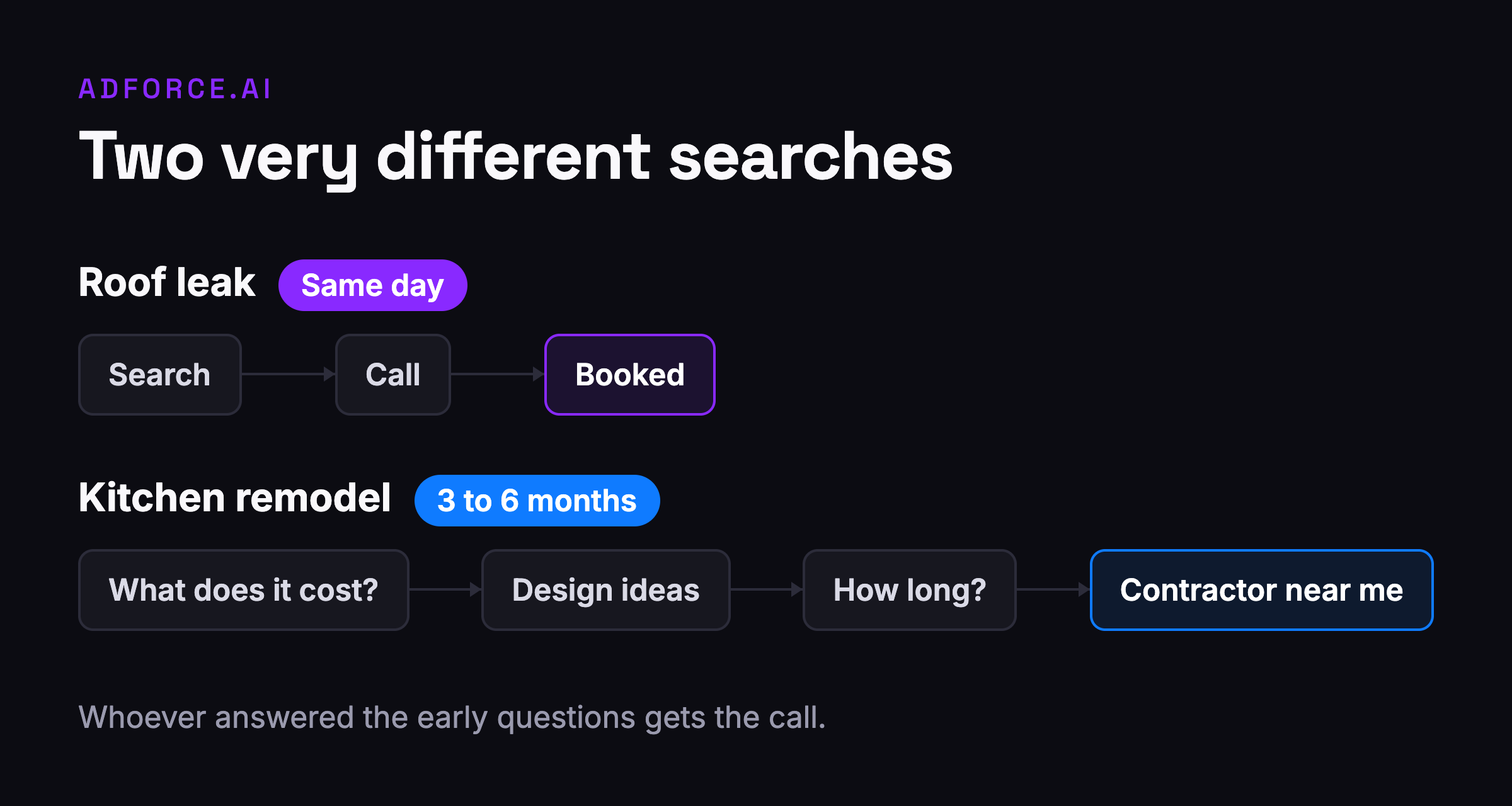
Here is the part that separates remodeling from a trade like roofing, which we cover on our SEO for roofers page. A roof leak is an emergency: the homeowner searches, calls three numbers and books one, sometimes inside an hour. The map pack decides it.
A kitchen is not that. It is six months of pinning photos, arguing about budget, and reading cost guides. By the time someone searches for a contractor, they already have opinions about what they want and roughly what it should cost, and those opinions were formed by whoever was answering their questions during those six months.
That is the opportunity, and almost nobody in the trade takes it, because writing about cost feels like giving something away. It is the opposite. The pages that answer "what does this cost and what changes the price" attract people at the exact moment their project becomes real, and they arrive already trusting the source. Our guide on how long SEO actually takes explains the timeline this work runs on, because a research-phase strategy compounds rather than switching on. We hold ourselves to the same standard: how much local SEO costs sets out the market's price bands and what each one actually buys, and we share clear pricing for your own scope on a free 15-minute call.
Your gallery is doing nothing for you
Nearly every contractor site has a portfolio, and nearly every one of them is a lightbox: a grid of thumbnails that expand, with filenames like IMG_4471.jpg and no text anywhere near them.
To a search engine that is a blank page. To a homeowner it is better than nothing but far worse than it could be, because the thing they want to know is not "is this pretty" but "have you done my job, in my kind of house, near me".
Project pages solve both. One page per completed job, with the scope, the materials, the town, the rough budget band and real photographs with descriptive alt text. Horizon Kitchen & Bath in Woodmere and Jersey City Renovation both run galleries built this way. It turns the work you already did into pages that rank and pages that sell, at the same time.
Towns, but only the ones you actually work in
Town pages exist to solve one specific problem, which is that Google Maps rankings depend on where the searcher is standing. Local pages matter for contractors the same way they matter for any trade, with one important difference: a remodeler's genuine service area is usually smaller than they claim. Driving ninety minutes for a bathroom is not a business.
We build a page for every town you genuinely serve, each carrying real local detail rather than a template with the name swapped. Building a hundred thin ones does more damage than having none, because Google reads them as duplicate content. That principle is identical across trades and it is covered in more depth on the roofers page and in our local SEO guide. For where these pages sit against every other way of getting work, see our ranking of lead generation channels for contractors.
Capture the lead on the page it landed on
All of this produces visitors on deep pages: a cost article, a project page, a single-service page. The most common failure at that point is a site that expects them to navigate to a contact form.
Every contractor build we ship carries quote capture on the page itself. Flying Eagles Remodeling and Royal Remodeling & Construction both work this way, and it is a web design decision as much as an SEO one, which is why we do not treat those as separate projects.
Where AI search fits
Homeowners increasingly open ChatGPT and ask what a remodel should cost or which contractor to trust. Those answers cite sources, and the content that earns a citation is the same content that ranks: specific, structured, honest about numbers. Nearly no remodeler has done this work yet, which makes it the cheapest advantage currently available in the trade. It is what our GEO service is for.
What you get, and what it looked like on real builds
- A page for every job you sell: Kitchen, bath, basement, addition, deck. Each with its own scope, its own price range and its own photos, so there is something specific for Google to rank instead of one page trying to be everything.
- Go narrow where it pays: We built an entire site for one service, bathroom remodeling in Syracuse, because a specialist page beats a generalist page on the search that matters. When a trade is worth owning, it gets its own footprint.
- Turn the portfolio into a ranking asset: Project pages, not a lightbox. Horizon Kitchen & Bath and Jersey City Renovation both run galleries built as crawlable pages with the job, the scope and the town attached.
- Answer the money question honestly: Published cost ranges with the variables named. It is the highest-intent search in home improvement and most contractors refuse it, which is why cost-guide sites that never did the work own the result.
- Capture the lead where it lands: Every one of these builds carries quote capture on the page the visitor arrives on, not buried on a contact page two clicks away.
- Prove it from day zero: A local search grid and rank tracker running before the first page ships, so month three is measured against month zero instead of a memory.
Client work - remodelers and general contractors
Across the trades we have built and run search presences for general contractors, remodelers, kitchen and bath specialists, renovation companies and chimney services in New Jersey and New York. The pattern that repeats: a page for every job worth selling, project galleries built as crawlable pages, honest cost content, and quote capture on the page the visitor actually lands on.
Frequently asked questions
What is SEO for contractors?
It is the work of getting a contracting or remodeling business found for the specific jobs it sells, rather than for the generic term "contractor". In practice that means a page for every service with real scope and pricing, content that answers the research questions homeowners ask months before hiring, project galleries built as crawlable pages, and a Google Business Profile kept active for the towns you genuinely work in.
How is contractor SEO different from roofing or plumbing SEO?
Emergency trades are decided in a single session: someone searches, calls, and books. Remodeling is a considered purchase researched over months, so the searches that produce work are job-specific and cost-specific rather than "near me". The map pack matters for both, but for remodelers the research-phase content is where the job is actually won.
Should I have one Services page or a page per service?
A page per service, every time. One page listing ten trades as bullets gives a search engine nothing specific to rank, so it ranks for none of them. Each job you want more of needs its own page with the scope, an honest price range, the timeline and photographs of that job type.
Should contractors publish prices on their website?
Publishing honest ranges with the variables named is one of the highest-return things a contractor can do. Cost is the highest-intent search in home improvement, and refusing to answer it hands the result to national cost-guide sites that have never done the work. A range plus an explanation of what moves it converts better than "request a quote".
Do project galleries help SEO?
Only if they are built as pages. A lightbox of thumbnails with filenames like IMG_4471 is invisible to a search engine. One page per completed project, with the scope, materials, town and descriptive alt text, turns work you already did into pages that both rank and sell.
How many town pages should a contractor build?
Only for the towns you genuinely serve, and each one has to carry real local detail rather than a template with the name swapped. Generating a hundred near-identical pages does more damage than having none, because Google reads them as duplicate content. A remodeler is usually better served by ten real ones than a hundred thin ones.
How long does contractor SEO take to work?
A Google Business Profile can move in two to eight weeks, job-specific and cost-specific pages typically start landing between month two and month four, and the competitive commercial terms take six to twelve months. Because remodeling has a long research cycle, early traffic often arrives on cost and how-to pages well before the "contractor near me" terms move.
Is SEO better than buying leads from Angi or Houzz?
They solve different problems. A purchased lead arrives today and is usually sold to several contractors at once, so you compete on response speed and price. A ranking takes months, is yours alone, and does not stop when you stop paying. Most contractors we work with keep buying leads while the organic work matures, then reduce it.
Do I need a separate website for each service?
Usually no, but sometimes yes. A page per service is the default. A dedicated site earns its place when a single trade is worth owning outright in a specific market, which is why we built an entire site for bathroom remodeling in Syracuse. It is a bigger commitment and should be a deliberate decision, not the starting point.
Will AI assistants recommend my contracting business?
They already recommend some. Homeowners ask ChatGPT and Google AI Overviews what a remodel should cost and who to trust, and those answers cite sources. The content that earns a citation is the same content that ranks: specific, well-structured and honest about numbers. Very few remodelers have done this work, which currently makes it a cheap advantage.