How to Rank Higher on Google Maps (and Why You Rank at Your Desk but Nowhere Else)
Quick answer: There is no single Google Maps ranking. You rank differently at every point on the map, because proximity to the searcher is one of the strongest factors and the one you cannot change. That is why you are number one when you search from your own desk and invisible three towns away. The signals you can move are your primary category, the completeness of your services and service areas, review volume and recency, and the pages on your website that give Google a reason to show you outside your immediate radius. Measure it with a grid of search points, not a single search from your office.
Published 2026-09-05 · Local SEO · by AdForce

You typed your business into Google Maps this morning and there you were, sitting at the top. Then a customer three towns over told you they could not find you at all. Both of you are telling the truth, and until that makes sense nothing else about local rankings will.
Here is what actually happened. Google Maps does not have a ranking. It has a map.
The reframe: your rank is a location, not a number
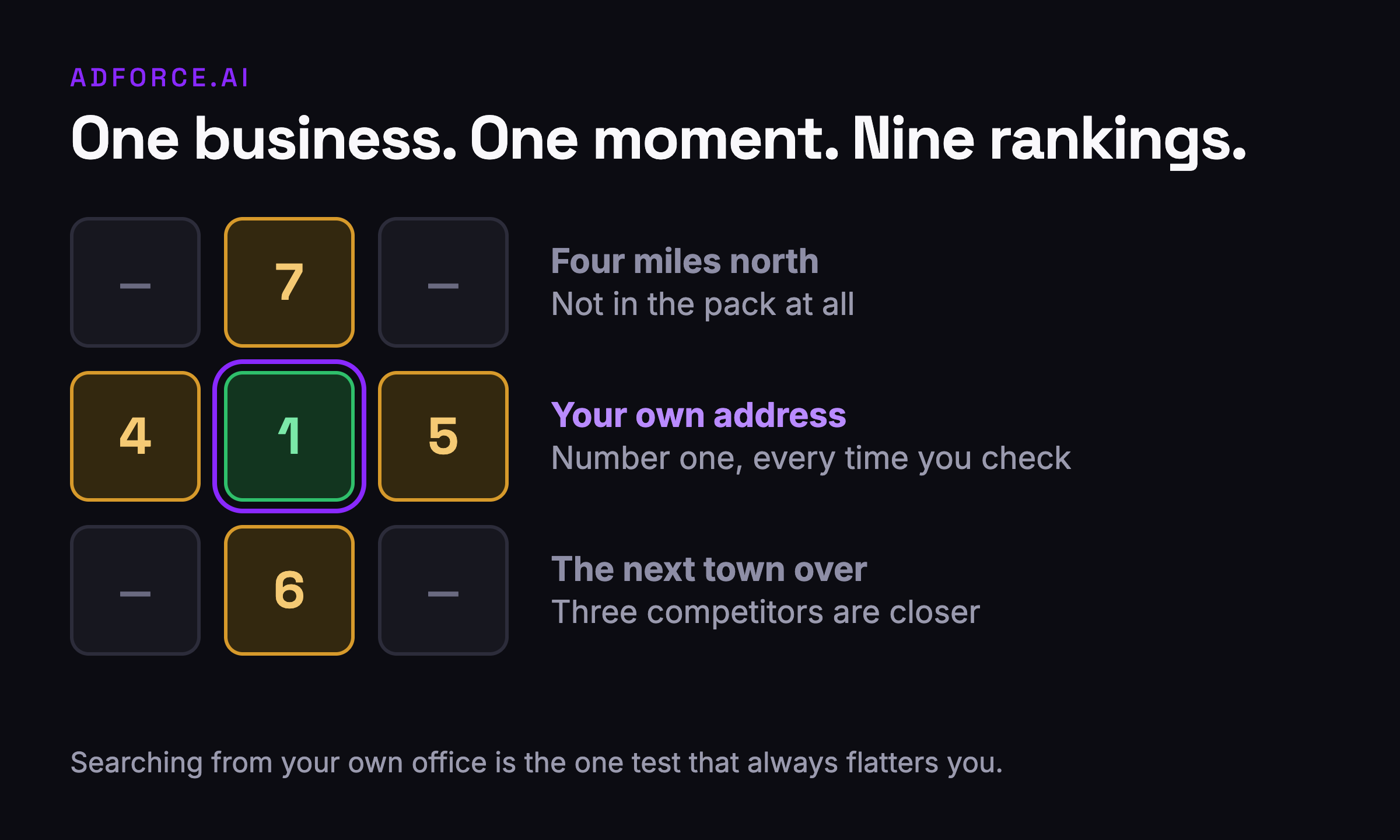
Every other kind of SEO trains you to think in positions. You are seventh for a keyword, you work, you become fourth. Local is not like that. The map pack is assembled fresh for each searcher based partly on where that searcher is standing, so you hold a different position at every point on the map at the same moment.
That single fact explains most of the confusion:
- You are number one from your office, because you are zero feet from yourself.
- You fall out of the pack four miles away, because three competitors are now closer to the searcher than you are.
- Your ranking "changes" day to day, when really you are just searching from different places or Google is testing.
Proximity is the factor you cannot change, short of moving. Everything below is about the factors you can, and about how to extend your reach past the radius proximity gives you for free.
| What actually moves your map ranking | Can you change it? |
|---|---|
| Proximity of the searcher to your address | No |
| Primary category | Yes, and it is the highest-leverage field you own |
| Services and service areas listed on the profile | Yes |
| Review volume, recency and what they mention | Yes, steadily |
| Website relevance for that service in that town | Yes, and this is how you beat proximity |
| Profile completeness, photos, hours, activity | Yes |
| Buying "citations" in bulk | Not any more, in any meaningful way |
Step one: fix your primary category before anything else
Your primary category is the single highest-leverage field on your Google Business Profile, and it is routinely set once at signup and never looked at again.
Google uses it to decide which searches you are even eligible for. "Roofing Contractor" and "Roof Repair Service" do not compete for identical sets of queries. Neither do "Plumber" and "Emergency Plumber". Pick the most specific category that genuinely describes your core business, then add secondary categories for the real services you offer.
Two rules that matter more than they sound. Be specific, because a narrow category with real demand beats a broad one where you are one of four hundred. And be honest, because categories you do not actually serve produce calls you cannot take and reviews you will not enjoy.
Step two: complete the profile properly, not partially
Most profiles are about sixty percent filled. The gap is free ranking:
- Services, each one listed with a real description rather than a bare name.
- Service areas, defined as the towns or zip codes you genuinely cover. Claiming half the state does not extend your reach, it dilutes your relevance.
- Hours, including the special ones. If you genuinely run emergency work, the "Open 24 hours" attribute is a real eligibility signal, not decoration.
- Photos, recent and real. Profiles with fresh photos get more calls and direction requests, and it is the cheapest thing on this list.
- Products, attributes and the business description, all of which give Google more text to match against.
Our local SEO guide walks the whole profile field by field if you want to work through it yourself.
Step three: make reviews continuous instead of a campaign
Review signals feed the map pack directly, and three things matter: how many, how recent, and what they say.
The word that does the work is steady. Twenty reviews arriving over six months beats forty in one week, which looks exactly like what it is. The fix is systematic: ask on every completed job, at the moment the customer is happiest, with a link that takes one tap.
The part most businesses miss is content. A review that says "great service" helps a little. One that says "replaced the flat roof on our Ocean Township warehouse" contains a service and a town, and Google reads it. You cannot script reviews, but you can ask a question that invites specifics rather than a rating.
Step four: use your website to beat proximity
This is the step that separates businesses that plateau from businesses that keep expanding, and it is the one people skip because it does not live inside the profile.
Proximity gives you a radius for free. To rank outside that radius, Google needs another reason to believe you are relevant to that town, and the profile alone cannot provide it. Your website can. A genuine page for each town you serve, carrying real local detail rather than a template with the name swapped, is what makes you a credible result four miles out.
The failure mode is well documented and we will not pretend otherwise: generating a hundred near-identical town pages does more harm than having none, because Google reads them as duplicate content. Ten real ones beat a hundred spun ones. We go deeper into how this plays out by trade on our SEO for roofers and SEO for contractors pages.
Step five: measure with a grid, not a search
Searching your own business name from your own office is the most misleading test in local marketing, and it is the one nearly every owner runs first.
The right instrument is a local rank grid: a set of search points spread across your service area, each one checking where you appear from that spot. Instead of a number you get a picture, usually green near your address fading to nothing at the edges. That picture tells you two useful things at once: how far your radius currently reaches, and which direction it is failing in, which is exactly where the next town page should go.
Run it before you change anything, so month three is measured against month zero rather than a memory. Our piece on how long SEO actually takes covers the timelines each of these signals moves on, and lead generation for contractors ranks the map pack against every other channel on cost per booked job.
What does not work any more
Worth naming, because these are still actively sold:
- Bulk citation blasts. Consistent listings on the handful of directories that matter is hygiene. Buying three hundred is not a ranking strategy.
- Keyword-stuffing your business name. "Joe's Plumbing | Emergency Plumber Miami Best Prices" is against the guidelines, is reportable by any competitor, and risks the profile itself.
- A virtual office to fake proximity. Google is good at detecting this, and a suspended profile costs more than the towns it was meant to win.
- Posting daily to the profile. Regular activity is a positive signal. Daily posting is not a lever, and it is not where your hour is best spent.
Putting it together
- There is no single ranking. You hold a different position at every point on the map.
- Proximity is fixed. Everything else on the list is not.
- The primary category is the highest-leverage field on the profile, and it is usually stale.
- Reviews compound, so make them continuous rather than a push.
- Town pages are how you beat proximity, and only real ones count.
- Measure with a grid, because a single search from your office tells you almost nothing.
That is the same sequence we run for clients across roofing, contracting, real estate and home services: the profile first because it moves fastest, the technical and local pages underneath it, then the content that widens the radius, with reporting tied to calls and booked jobs instead of a screenshot of a ranking. Real strategists own the plan; the best AI does the heavy lifting in between, which is why the work stays consistent month after month.
If you want to see what your own grid looks like today, book a free 15-minute call. We will run it, show you how far your radius actually reaches, and tell you honestly whether the fix is your profile, your website, or neither. Our local SEO service runs the whole loop when you would rather hand it over, and how much local SEO costs sets out the market's price bands and what each one buys, with clear pricing for your own scope shared on that call. Because the same structured content feeds AI search, the work increasingly pays off there too.
Frequently asked questions
How do I rank higher on Google Maps?
Start with your primary category, which is the highest-leverage field on the profile and is usually set once and forgotten. Then complete services, service areas, hours and photos properly, build reviews steadily rather than in bursts, and add genuine town pages to your website so Google has a reason to show you outside your immediate radius. Measure with a rank grid rather than a single search.
Why am I number one on Google Maps at my office but not elsewhere?
Because proximity to the searcher is one of the strongest map-pack factors, and from your own office you are zero distance from yourself. There is no single ranking: you hold a different position at every point on the map. That is normal, and it is why a rank grid is the only honest way to measure local visibility.
How long does it take to rank higher on Google Maps?
Profile changes such as category corrections, completed services and fresh photos can shift visibility within two to eight weeks, which makes it the fastest-moving asset in local marketing. Extending your radius into towns further out depends on website content and takes longer, typically a few months, because it relies on pages that have to be built and indexed first.
Does my primary category really matter that much?
Yes, more than any other single field. It determines which searches you are eligible to appear for at all. A specific category that matches your core service usually outperforms a broad one where you compete with hundreds of businesses, and secondary categories can cover the rest of what you offer.
Do citations still help Google Maps rankings?
Consistent business information on the handful of directories that matter is basic hygiene and worth getting right once. Buying hundreds of citations in bulk is not a ranking strategy and has not been for years. Effort is far better spent on category accuracy, reviews and local website content.
How many reviews do I need to rank in the map pack?
There is no threshold number, because it is relative to your competitors in that area and it is not only volume that counts. Recency matters, and so does what the reviews actually mention, since a review naming a specific service and town gives Google usable text. A steady flow beats a large batch that arrives at once.
Can I rank in towns where I do not have an address?
Yes, but not through the profile alone, because proximity works against you. The way through is genuine local content on your website: a real page for each town you serve, carrying detail specific to that place. Thin templated pages with the town name swapped in do more harm than good.
What is a local rank grid?
A tool that checks your map ranking from many search points spread across your service area rather than one. Instead of a single number you get a picture of where you appear and where you disappear, which shows both how far your current radius reaches and which direction to expand next.
Should I put keywords in my Google Business Profile name?
No. Using anything other than your real business name is against Google guidelines, any competitor can report it, and the risk is suspension of the profile itself. Whatever short-term lift it produces is not worth losing the asset that drives most of your local calls.