How Long Does SEO Actually Take? A Realistic 12-Month Timeline
Quick answer: There is no single SEO clock, which is why "three to six months" satisfies nobody. Four things move at four different speeds: your Google Business Profile can shift in two to eight weeks, new pages get indexed in days, long-tail rankings land around month two to four, and genuinely competitive commercial terms take six to twelve months. The other half of the answer is when the clock starts. It starts on the day the first new thing goes live, not the day you sign, and on most builds those are six weeks apart.
Published 2026-08-25 · Local SEO · by AdForce

You signed three months ago. You have paid three invoices. Someone sends you a report full of words like impressions and average position, and you still cannot answer the only question you actually have, which is whether this is working. So you ask how long it takes, and you get "three to six months," and you are no better off than before you asked.
That answer is not dishonest. It is just useless, because it answers a question nobody asked. Three to six months for what? Ranking for your own business name takes days. Getting your Google Business Profile into the map pack for a service you already offer can happen in weeks. Outranking an established competitor for the most valuable commercial term in your market can take a year, and on some sites it will not happen at all without a different strategy.
Those are not three points on one timeline. They are three different processes with three different mechanics, and averaging them into a single number is what makes every SEO answer sound evasive.
The reframe: there is no single SEO clock, there are four
Here is the shift that makes the whole thing legible. Four separate things are moving at once, at wildly different speeds, and each one is controlled by something different.
| What you are waiting for | Realistic window | What actually controls it |
|---|---|---|
| Google Business Profile and map pack | 2 to 8 weeks | Category accuracy, service coverage, review flow, proximity |
| New pages getting indexed | Days | Sitemap, internal links, crawl budget, page quality |
| Long-tail article rankings | Month 2 to month 4 | How contested the question is, how completely you answer it |
| Competitive commercial terms | Month 6 to month 12 | Site authority, cluster depth, how entrenched the incumbents are |
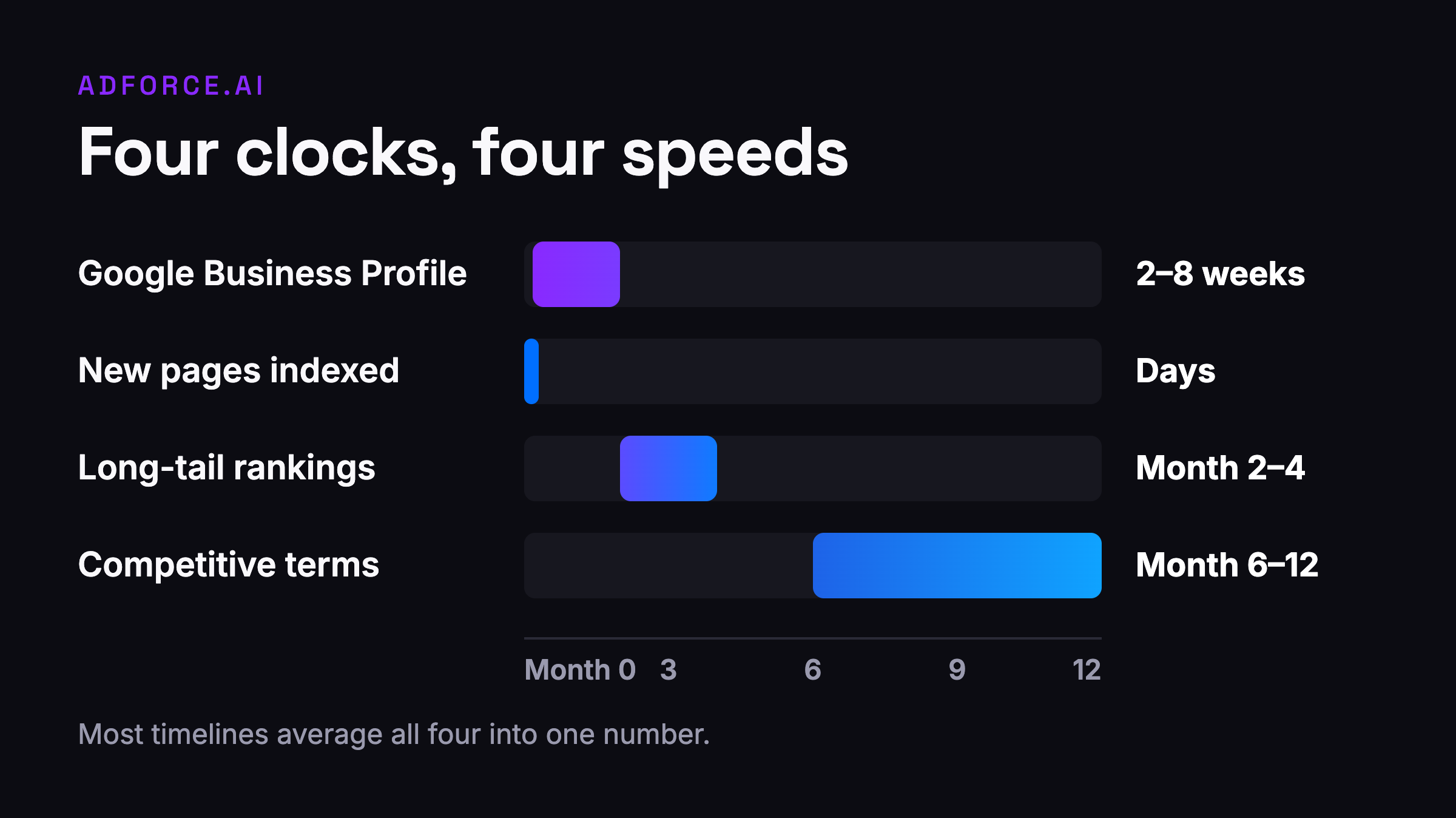
Notice what falls out of that table: the fastest clock is the one most businesses touch last. Your Google Business Profile is the single quickest-moving asset you own, and it is routinely left half-filled while everyone argues about the website.
Step one: start the clock on the right date
Most disappointment in month three is not a ranking problem. It is a counting problem. You are counting from the day you signed. Google is counting from the day something changed.
Between those two dates sits the work that has to happen before anything can rank: fixing whatever is wrong with your location data, mapping your old URLs to redirects so you do not throw away years of history, and building the pages themselves. On a typical build that gap is around six weeks.
We can be specific about it, because we run the account. When we started with Green Apple Roofing in New Jersey, the first deliverable was not a line of website copy. It was a Business Profile audit, because that is the fastest clock and there was no reason to make it wait on the site. The site audit then turned up six office addresses on the existing website, each with its own phone number, only one of which was a place the business actually operated from. Whatever the reasoning behind the other five, the effect was that the company's location signals were spread across towns it did not occupy, which is close to the most damaging thing a local business can do to itself in search.
So the first weeks went into correcting that, mapping all 35 of the old site's pages to permanent redirects, and building 74 town pages that had to be genuinely different from one another rather than one template with the name swapped. The first article went live in mid-July. Six weeks from kickoff.
None of those six weeks were Google being slow. Google had nothing new to look at.
The practical version for you: ask your agency, or yourself, one question. On what date does the first new thing go live? If the honest answer is week six, then "three months of SEO" is really six weeks of SEO with six weeks of construction in front of it. If the answer is week one because nobody checked the location data or built a redirect map, you will see faster movement and then lose it, because the underlying problems are still there.
Step two: fix the fastest clock first
If you do nothing else in month one, do this. The Business Profile responds faster than anything else you own, and most profiles have real gaps:
- Primary category. The single highest-leverage field on the profile. "Emergency Plumber" and "Plumber" do not compete for the same searches.
- Services and service areas. Every service listed with a real description, every city or zip you genuinely cover.
- Reviews, steadily. Twenty over six months beats forty in one week, and review velocity feeds the map pack directly.
- Photos and posts. Recent, real, and regular. They signal an active business rather than a listing.
This is the same order of operations whether you are a contractor, a law firm, or a real estate team, because the map pack is ranked mostly on the profile and proximity, while your website ranks on content and authority. They are separate systems. Work the fast one first. Our local SEO guide is the full playbook if you want to run it yourself.
Step three: publish on a cadence, not in batches
Once the foundation is right, the second clock is content, and consistency beats volume by a wide margin.
Green Apple runs on eight pieces a month, planned from keyword data before a word is written, each one linking into the cluster it belongs to. The detail that matters more than it sounds: we stagger the publishing. Several pieces are often built in the same week, but they go live days apart. A site that publishes two articles on one day and nothing for two weeks reads as a batch upload. A site publishing steadily reads as an active business, and that is what gets crawled more often.
The rankings that arrive first are the long-tail ones, on specific question-shaped searches nobody is fighting over. Lower volume, much higher intent, and they compound. Eight pieces that reinforce one subject will outrank thirty scattered ones every time, because depth on a topic is what the algorithm is actually measuring.
Step four: watch the four signals that move before rankings do
You do not have to sit blind for six months. Four leading indicators move well ahead of position:
- Pages indexed. New pages should appear in Search Console within days. If they are not, nothing downstream matters and you have a technical problem to fix this week.
- The shape of your queries widens. Before positions improve, the set of searches you appear for should grow. That means you are becoming visible across more of the topic.
- Business Profile actions. Calls, direction requests and website clicks respond far faster than organic rankings, and they are real customer behaviour rather than a proxy for it. A local rank grid shows you the same thing geographically, which is more useful than a single position.
- Movement inside the top 30. Going from position 45 to position 18 produces almost no traffic and is nonetheless the clearest signal in the dataset that the direction is right.
If all four are moving and traffic has not, the strategy is right and you are early. If none of them are moving by month three, the strategy is wrong and you should change it. That distinction is the entire value of watching them.
Step five: do not restart the clock at month three
This is the expensive mistake, and it is worth naming plainly.
Month three is exactly when the long tail is starting to land and the head terms have not moved yet. It feels like failure at the precise moment it is working. Switching direction here restarts the construction period and throws away the part that was almost finished, which is how businesses end up three years into SEO with eighteen months of actual progress.
| Month 3 looks like | What is usually true |
|---|---|
| "We are not ranking for anything that matters" | The long tail is landing; head terms are on a different clock |
| "Traffic has barely moved" | Query spread is widening, which precedes traffic |
| "Time to try something else" | Restarting costs you the six weeks of setup all over again |
What AI search does to the timeline
There is a fifth clock now, and it is the reason to start sooner rather than later.
AI answer engines cite clear, well-structured, question-shaped content, and most local businesses are not competing for those citations at all yet. The work overlaps almost entirely with classic SEO, which means the content you publish for month-three long-tail rankings is the same content that earns you an AI citation. That is unusual, and it will not stay uncontested. Our guides on GEO versus SEO and how to get recommended by ChatGPT cover the difference, and GEO is the service that runs it.
Putting it together
- Four clocks, not one. Profile in weeks, indexation in days, long tail month 2 to 4, competitive terms month 6 to 12.
- Count from the first thing that goes live, not from the day you signed. On most builds those are six weeks apart.
- Setup is not slow SEO. Redirect maps, location cleanup and category accuracy are what stop you rebuilding in month eight.
- Publish steadily, not in batches. Depth on one subject beats volume across many.
- Watch indexation, query spread, profile actions and top-30 movement while you wait for positions.
- Month three is the trap. It looks like failure and it is usually the middle of the build.
We run this exact sequence for clients across roofing, general contracting and remodeling, real estate and professional services: the Business Profile first, the technical foundation before the content, then a locked monthly calendar that feeds classic search and AI search at the same time, with reporting that ties the work to calls and booked jobs rather than vanity rankings. Real strategists own the plan; the best AI does the heavy lifting in between, which is why the cadence holds month after month instead of slipping.
If you want an honest read on where your own clock actually starts, book a free 15-minute call. We will tell you what your runway looks like before you commit to anything, including if the answer is that you do not need us yet. For how this plays out in one trade specifically, see SEO for roofers; for what to run while the slow clocks tick, our ranking of lead generation channels for contractors; and for what the whole thing costs, how much local SEO costs. We tailor a plan to your goals and budget and share clear pricing on the call.
Frequently asked questions
How long does SEO take to show results?
It depends which result you mean. A Google Business Profile can move in two to eight weeks, new pages get indexed within days, long-tail article rankings typically land between month two and month four, and competitive commercial terms take six to twelve months. Averaging those into one number is what makes most SEO timelines feel misleading.
Why is my SEO not working after 3 months?
Month three is usually the middle of the build rather than the end of it. Check the leading indicators instead of positions: are new pages being indexed, is the range of searches you appear for widening, are Business Profile actions rising, and are keywords moving inside the top 30? If those are moving, the strategy is working and you are early. If none of them are, the strategy needs changing.
When does the SEO clock actually start?
On the day the first new thing goes live, not the day you sign. On a typical build those are about six weeks apart, because location data has to be corrected, old URLs mapped to permanent redirects, and the pages themselves built before anything can rank. That setup is not slow SEO, it is what stops you rebuilding in month eight.
How long before a new website ranks on Google?
Indexation takes days, but ranking is a different question. A new site that replaced an old one with proper permanent redirects carries its history forward and can rank quickly. A new site launched without redirects effectively starts from zero, which is the single most expensive avoidable mistake in a website migration.
Does local SEO work faster than regular SEO?
Usually yes, because the Google Business Profile is the fastest-moving asset in the whole system and it is often the least optimized. Fixing the primary category, completing services and service areas, and building a steady review flow can shift map-pack visibility in weeks, well before any website change takes effect.
How much content do I need before SEO starts working?
Less than most people think, but more consistently than most people manage. A steady cadence of pieces that reinforce one topic beats a large batch of unrelated articles, because rankings follow demonstrated depth on a subject. Eight cross-linked pieces on one theme outperform thirty scattered ones.
Should I switch SEO agencies if I see no results in 3 months?
Rarely, and month three is the worst possible moment to do it. Switching restarts the construction period and discards work that is typically close to landing. Before deciding, ask for the leading indicators: indexation, query spread, profile actions, and movement within the top 30. Those tell you whether the direction is right far more reliably than current rankings.
Does AI search have its own timeline?
It runs roughly alongside the long-tail clock, because AI engines cite the same clear, question-shaped, well-structured content that earns long-tail rankings. The difference is competition: most local businesses are not chasing AI citations yet, so the same content can earn visibility there sooner than it does in classic search.